
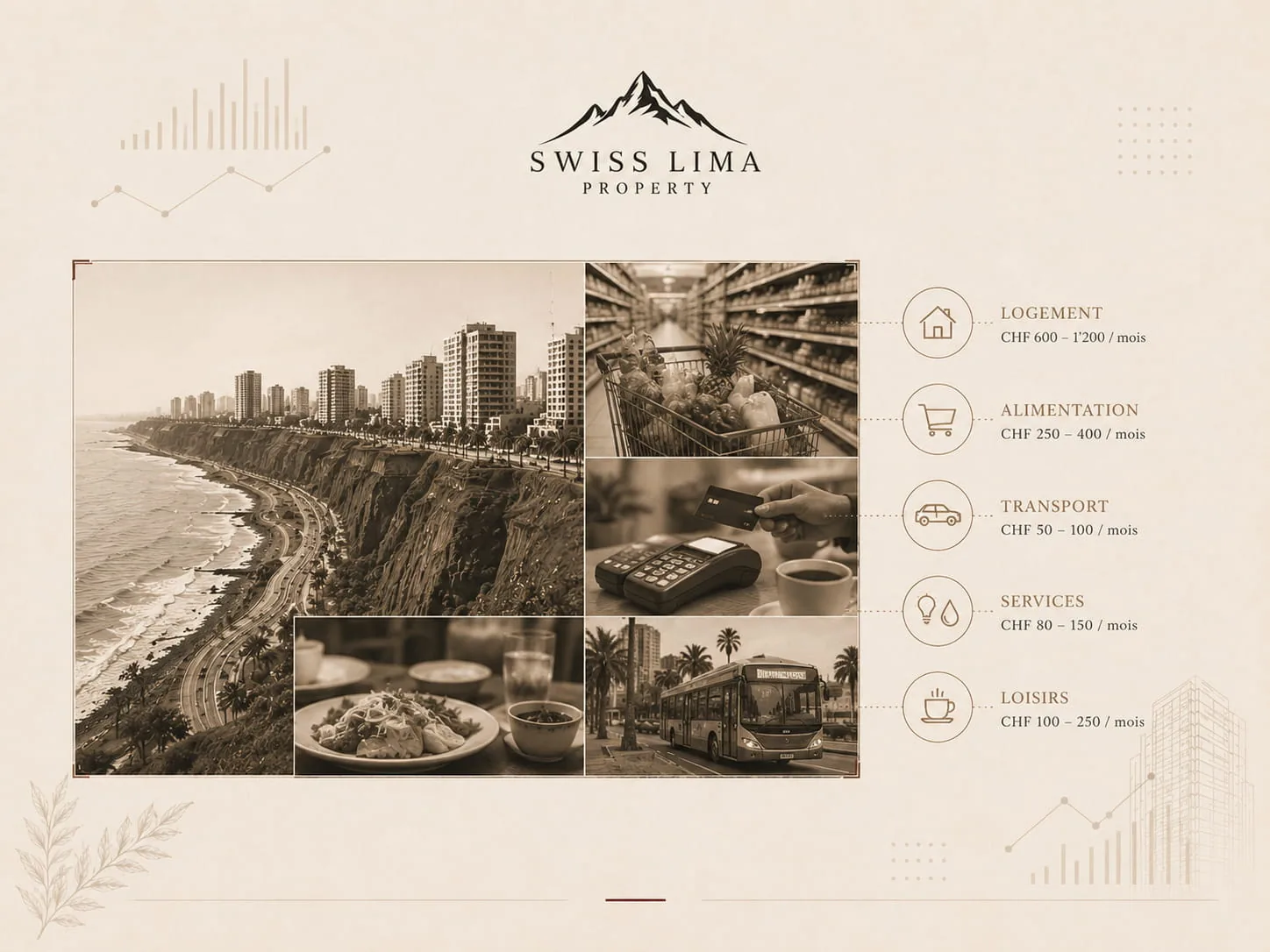
A cost of living that depends on context
Peru is not uniformly "cheap". This claim, often heard from travellers or people comparing the price of a local restaurant menu to Zurich standards, does not reflect the reality of an expat trying to maintain a level of comfort comparable to what they know in Europe.
Some spending categories are indeed noticeably more affordable in Peru than in Switzerland or France: food at local markets, public transport, routine medical care and domestic services. Other categories, such as housing in Lima's premium residential districts, international schools, leading private clinics or high-end dining, can approach or match European standards.
This guide does not aim to sell the image of an unaffordable Peru or a bargain-basement paradise. It seeks to give a realistic, structured reading of the main spending categories, based on published and verifiable data.
Housing
Housing is the most variable and most decisive item in an expat's budget in Lima. Rental prices depend on the district, the quality of the building, the services included (security, parking, lift, pool, gym) and the condition of the property.
In the most sought-after districts, such as Miraflores, Barranco and San Isidro, a furnished one-bedroom apartment generally rents for between 500 and 900 USD per month. For a well-located two-bedroom apartment, expect most often between 750 and 1,300 USD, depending on size, condition, building services and exact location. Particularly spacious or upmarket properties can naturally exceed these amounts.
In more affordable residential districts, such as Magdalena del Mar, Pueblo Libre or San Miguel, it is possible to find a one- or two-bedroom apartment between 400 and 850 USD per month. San Borja can be slightly more expensive depending on the area and the size of the property.
These amounts correspond to listed rents and remain indicative. Condominium fees are generally billed separately.
It is worth noting that rents in Lima's premium districts are generally quoted in USD. Fluctuations of the Peruvian sol against the dollar can have an impact if your income is in soles.
Food
Food is one of the categories where Peru offers a real advantage compared to Switzerland or Western Europe. Local markets (mercados de abastos) offer fresh vegetables, fruit, meat and fish at very affordable prices. Major supermarket chains (Wong, Metro, Tottus, Plaza Vea) offer competitive value for everyday products.
Someone who cooks regularly at home and shops at a supermarket or neighbourhood market can aim for a food budget of around 800 to 1,200 soles per month, roughly 210 to 320 USD at the indicative mid-2026 exchange rate. This estimate comes from data published by platforms specialising in cost of living and should be treated as an order of magnitude.
Restaurants represent a notable comparative advantage. A full meal at a neighbourhood restaurant costs between 15 and 35 soles (around 4 to 9 USD). Lima is recognised as one of the world's culinary capitals: its high-end restaurants (Central, Maido, Astrid y Gastón) charge rates close to major European fine-dining venues, between 150 and 300 soles per person excluding drinks. To better understand this culinary scene beyond price alone, our guide to Peruvian gastronomy presents its main regional traditions.
Transport
Lima has a public transport network that has developed in recent years. The Metropolitano (dedicated-lane bus connecting the north and south of the city) and Línea 1 of the light metro (east-west axis) form the backbone of the network. Fares are very affordable, with a monthly card top-up costing a few dozen soles.
Ride-hailing apps (Uber, InDriver, Cabify) are widespread and are the preferred mode of transport for expats and residents of premium districts. A ride within Lima generally costs between 5 and 30 soles depending on distance and service (around 1.5 to 8 USD). Moderate daily use of ride-hailing represents a budget of around 200 to 500 soles per month (55 to 130 USD).
In dense districts like Miraflores or San Isidro, a personal car is not essential. The costs associated with a vehicle (insurance, parking, fuel, maintenance, roadworthiness inspection) can represent a significant additional budget in Lima, particularly due to traffic density.
Healthcare and insurance
Peru's healthcare system operates at two speeds: the public sector (SIS, EsSalud) is accessible to residents with variable coverage, while the private sector, noticeably faster and better equipped, is preferred by the vast majority of expats.
In Lima's private clinics (Clínica Anglo Americana, Clínica San Felipe, Clínica Internacional, Clínica Ricardo Palma), a general practitioner consultation costs between 80 and 200 soles (20 to 55 USD). A specialist consultation is generally between 100 and 250 soles (25 to 65 USD). Prescription medicines are generally cheaper than in Europe, with pharmacy chains (Inkafarma, MiFarma) offering affordable prices.
Private health insurance for an expat, covering outpatient care and hospitalisation in Lima's private clinics, can range from 100 to 350 USD per month depending on profile, age and desired coverage level. These amounts are indicative: consult a specialist international insurance broker for a personalised quote.
Swiss health insurance (LAMal) generally does not cover care abroad, except emergencies. An expat settling long-term in Peru should check their coverage situation with their health fund before leaving.
Services, dining and leisure
Utility bills for an apartment in Lima (water, electricity, gas) average between 150 and 350 soles per month (40 to 90 USD) for a standard apartment. This budget can increase in summer if the apartment has air conditioning used intensively.
Home internet in Lima offers decent speeds (50 to 300 Mbps) for monthly subscriptions of 80 to 150 soles (21 to 40 USD). Mobile coverage is dense in residential districts. Prepaid or monthly phone plans are affordable.
Leisure options in Lima are varied: cinemas, museums (Larco, MALI), theatres, concerts, sports clubs and beaches in summer. Quality gym memberships in premium districts (Gold's Gym, Smart Fit, private residential clubs) range between 100 and 300 soles per month. High-end sports clubs with pool and tennis courts can represent membership budgets close to European standards.
Considering investing in Lima?
A well-located apartment in Lima can serve both as a patrimonial asset and a pied-à-terre for your stays. Swiss Lima Property supports you in analysing and selecting properties suited to your project.
Local budget vs. expat budget
The distinction between living "a la limeña" and living like a European expat in the premium districts is real and significant. It has less to do with a difference in objective prices than with lifestyle choices: premium residential district or intermediate district, private clinic or public doctor, supermarket or local market, fine-dining restaurant or neighbourhood canteen.
A single Peruvian professional earning a middle-class salary can live in Lima on 3,000 to 5,000 soles per month (800 to 1,300 USD), all costs included in a standard district.
A Swiss or European expat wishing to maintain a standard of living comparable to what they know in a major European city, housing in a safe and pleasant district, private health insurance, quality dining, access to leisure, regular travel, should plan for a monthly budget of 2,000 to 4,000 USD depending on their family situation and consumption habits. For a couple, fixed costs (housing, utilities) are shared but personal items (health, leisure) add up. Beyond the budget, attitudes toward money and social status also differ between the two cultures: our guide on cultural differences between Peru and Switzerland covers these gaps in detail.
Lima, secondary cities and tourist areas
Lima has the highest rents in the country, particularly in its premium residential districts. Arequipa, Peru's second city, offers a noticeably lower cost of living than Lima with a pleasant living environment (sunny climate, colonial architectural heritage). Trujillo and Piura, on the northern coast, also offer less costly options but with a more limited range of international services.
Cusco is a special case: as a major tourist city, consumer prices there can be high in areas frequented by visitors. It is not a city suited to a long-term settlement for an expat seeking comprehensive international services.
Coastal areas (Máncora, Paracas, Asia) experience seasonal price peaks. Some second-home owners live there at a lower cost outside the season, but the range of year-round services is limited.