
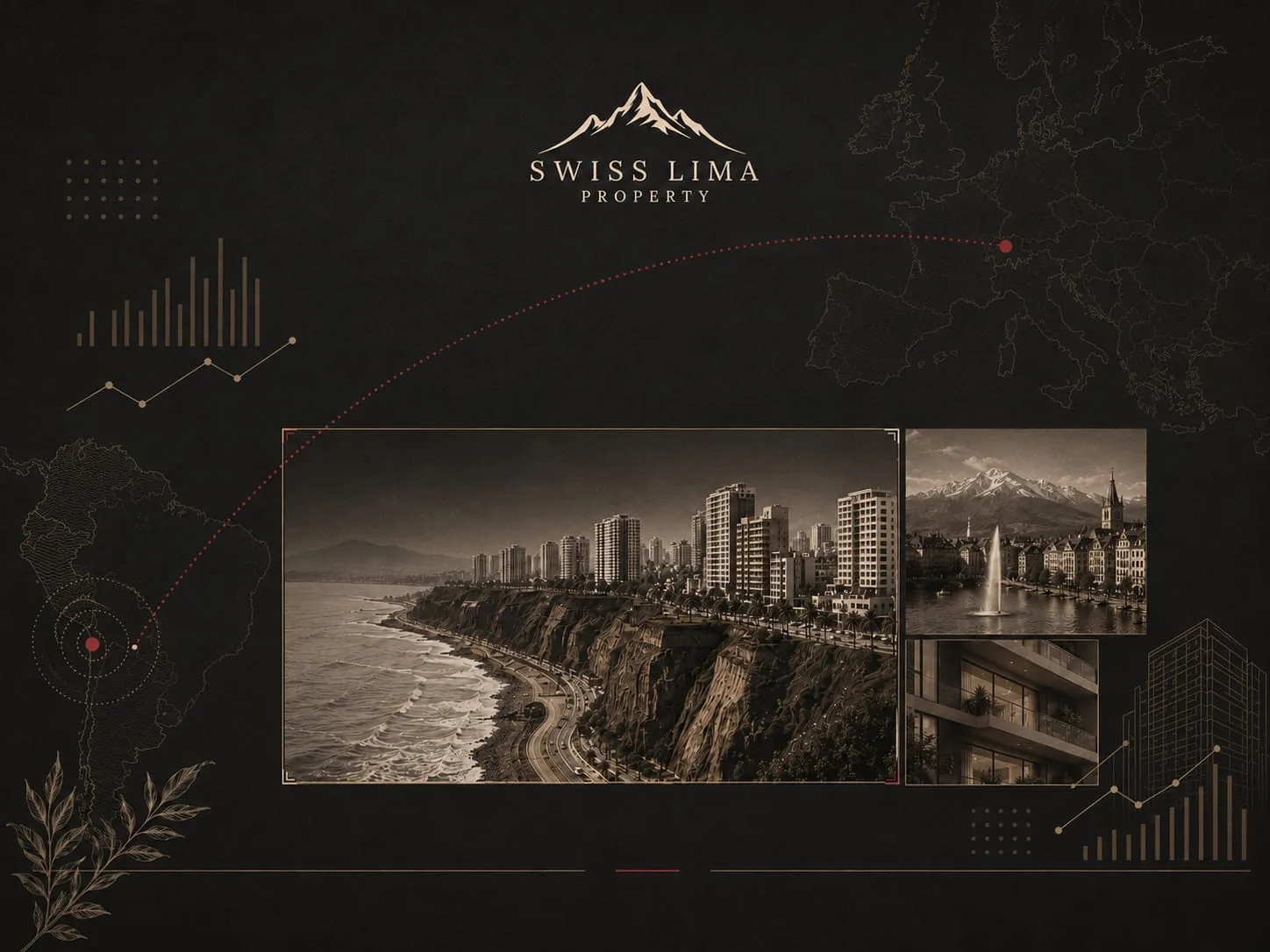
Why Lima interests Swiss investors
Switzerland is one of the most expensive real estate markets in the world. According to UBS Real Estate Focus 2024, the average price of an apartment in Geneva or Zurich far exceeds CHF 15,000/m². In this context, Swiss investors naturally seek to diversify their assets towards markets offering better rental-yield prospects.
Lima presents an interesting profile in several respects: a steadily growing economy, a structural shortage of formal housing in the upper-middle classes, a legal framework favourable to foreign buyers and prices still accessible by European standards.
The Peruvian currency, the sol (PEN), is relatively stable against the US dollar, and real estate transactions in Lima are generally denominated in USD. For a Swiss investor, exchange-rate exposure is therefore mainly USD/CHF, a known and manageable risk.
Price comparison: Lima vs Swiss markets
To illustrate the price differential, here are indicative market data (2025):
- Geneva (premium districts): CHF 15,000–22,000/m² (source: UBS, Wüest Partner)
- Miraflores, Lima (premium new-build apartments): USD 2,500–3,500/m², i.e. approximately CHF 2,000–2,800/m² at the indicative exchange rate of July 2026 (to be verified before any decision)
- San Miguel, Lima: USD 1,600–2,400/m²
These figures are indicative. No guarantee of capital gain can be given.
In terms of gross rental yield, the estimates available for Miraflores and San Isidro are, indicatively, between 5% and 6.5% per year, compared to 2% to 3% in most large Swiss cities. Figures not guaranteed; detailed analysis during our conversation.
Ready to explore the Lima market?
Browse the properties that Swiss Lima Property selects, with price, size and neighbourhood information to refine your thinking.
Legal framework: foreigners' rights in Peru
The Peruvian Constitution is explicit: its Article 71 guarantees foreigners the same property rights as Peruvian citizens. No prior purchase authorisation is required within the meaning of Article 71, and no acquisition quota exists. A Swiss national can therefore buy an apartment in Lima on the same basis as a Peruvian resident. However, if you sign the deeds physically in Peru, some notaries may require a special Migraciones permit to sign documents depending on your immigration status (gob.pe/12614).
The only legal restriction concerns properties located within 50 kilometres of land borders, where acquisition by foreigners is limited for reasons of national security. This restriction does not concern Lima or any coastal area.
In practice, the procedures involve important specifics: obtaining a RUC (tax number) from SUNAT, using a Peruvian notary to sign the deed of sale, registering the title with the Registros Públicos (public land registers). These steps are detailed in our buying guide for foreigners.
The steps of a property acquisition in Lima
A standard property acquisition in Lima proceeds in several phases:
- Identifying and selecting the property: viewing (in person or via a representative), analysis of the location, the condition of the property and the local market.
- Due diligence: verification of the title deed (Partida Registral) at the Registros Públicos, checking the absence of charges, mortgages or disputes. This step is indispensable and must never be skipped.
- Preliminary agreement (Minuta de Compraventa): signing a sale agreement with a deposit. The amount of the deposit is negotiable, often 10% to 20% of the price depending on the transaction.
- SUNAT/RUC tax identification: depending on the transaction and the associated tax obligations (rental, resale), the foreign buyer may need to register with SUNAT to obtain a RUC (Registro Único de Contribuyentes); to be confirmed with the notary and a local lawyer.
- Notarial deed (Escritura Pública): signing before a notary, payment of the balance and transfer of ownership. The buyer can also be represented by power of attorney. For tourists or students signing in Peru, a special Migraciones permit may be required. We are also working on a legal remote-signing solution: contact us to find out what is possible for your file.
- Registration with the Registros Públicos: registration of the new title deed. This step makes the transfer enforceable against third parties and ensures the legal protection of the title against any third-party claim, without retroactively validating all prior acts.
The total duration of a transaction, from the signing of the preliminary agreement to registration, is generally 4 to 8 weeks. We will check the timelines on a case-by-case basis, as they can vary.
Acquisition fees and costs
Acquisition costs in Lima generally include:
- Notary fees: approximately 0.3% to 1% of the sale price.
- Registros Públicos registration fees: approximately 0.5% to 1% of the price.
- Alcabala tax: a Peruvian tax on the transfer of a property, generally payable by the buyer. It is calculated at a rate of 3% on the higher of the sale price or the fiscal value of the property, after deducting 10 UIT. The UIT (Unidad Impositiva Tributaria) is a fiscal reference unit whose value is revised each year. For a new-build sold for the first time by the developer, the construction is exempt, but the value of the land may remain taxable. The exact amount must be confirmed according to the property, the municipality and the applicable regulations.
- Lawyer or representative fees: variable depending on the providers.
In total, acquisition costs generally represent 4% to 7% of the sale price. They must be provisioned from the start of the project. These estimates are indicative and must be confirmed by a local professional.
Financing: own funds or local credit
Most foreign non-resident investors finance their acquisition in Lima with own funds transferred from abroad. A Peruvian mortgage is possible in principle for non-residents, but the conditions are generally more restrictive and local interest rates are significantly higher than in Switzerland or Europe. This point should be verified directly with Peruvian banks, as conditions vary by institution, borrower profile and property type. Some European investors also use financing structured outside Peru (a Swiss or European mortgage secured against other assets, Lombard credit, etc.) depending on their asset situation.
Whatever the financing method, the international transfer of funds to Peru must be properly documented (source of funds, banking KYC compliance), in accordance with Peru's bancarization law (Ley N° 28194).
Taxation: Peru and Switzerland
On the Peruvian side
Non-residents are taxed by SUNAT on:
- Property rental income: Peruvian-source rental income received by a non-domiciled owner may be subject to approximately 5% according to SUNAT when the tenant is domiciled in Peru; the modalities differ if the tenant is not domiciled in Peru. This point remains subject to the owner's tax status, reporting obligations, any taxation in the country of residence and applicable tax treaties, and must imperatively be validated with a qualified Peruvian tax adviser before any investment.
- Resale and capital gain: the taxation applicable to a resale or a potential capital gain depends on the owner's tax status, the nature of the property and the transaction. It must be validated with a Peruvian tax adviser or lawyer before any transaction.
On the Swiss side
In Switzerland, the worldwide income of Swiss residents is in principle taxable. Rental income received in Peru must be declared to the competent Swiss tax authorities. Switzerland and Peru have concluded a double taxation agreement (DTA), which entered into force on 10 March 2014. This agreement may help avoid double taxation on Peruvian-source income.
Managing a property in Lima from Switzerland
Managing a property 10,000 kilometres away presents real challenges: finding and selecting reliable tenants, ensuring the maintenance of the property, dealing with the unexpected, complying with local tax obligations. Without a trusted local partner, these challenges can quickly become obstacles.
The available solutions include:
- Local rental-management agency: partial or complete delegation of the management of the property. For a long-term rental, fees vary depending on the services included.
- Short-term / Airbnb rental: potentially more profitable, but requiring more intensive management. Our partner Havenbnb Peru offers full-service management in Lima, including the creation and optimisation of listings, bookings, communication with guests, cleaning, maintenance and monitoring of the property.
The quality of the local partner is one of the decisive factors in the performance of a real estate investment in Lima. See our dedicated guide: Rental management in Lima: why the local partner is essential.
Districts in Lima: which choice for investment?
The choice of district determines the tenant profile, the rent level and the liquidity at resale. The six districts most cited by foreign investors present distinct profiles:
- Miraflores: the premium district par excellence. Strong rental demand from expats and high-end tourists. High liquidity. The highest prices in Lima.
- San Isidro: financial and diplomatic centre. Executive and corporate tenant profile. Long-term rental demand from companies and international organisations. Price level comparable to Miraflores.
- Barranco: bohemian and cultural district, prized by creatives, digital nomads and expats. Attractive for short-term rentals. A distinct atmosphere from San Isidro.
- San Miguel: coastal district, more accessible than Miraflores, with established local residential demand and good access to the Costa Verde. Entry prices generally lower than the premium districts. On the rise but to be analysed case by case.
- Surco / La Molina: family residential districts, upper-middle class. Rents often more moderate. Local rather than expat demand.
- Jesús María / Magdalena: intermediate districts with solid local demand and more affordable entry prices. An alternative for investors sensitive to the entry price.
For a detailed analysis by district, see our page Sought-after districts in Lima.
Risks and points of vigilance
Points of vigilance
- USD/CHF exchange-rate risk: property transactions in Lima are denominated in USD. An appreciation of the CHF against the dollar erodes the value of the investment expressed in Swiss francs.
- Liquidity risk: the Lima real estate market is less liquid than the Swiss market.
- Title-related risk: some properties in Peru may present disputed, incomplete or poorly registered titles. Verification with the Registros Públicos is therefore indispensable. It is also to avoid this type of difficulty that we support our clients throughout the buying process.
- Swiss tax situation: the Switzerland-Peru DTA (in force since 10 March 2014) may reduce the risk of double taxation, but its practical application arrangements remain to be verified with a qualified tax adviser familiar with both regimes.
- Peruvian political context: the country regularly experiences periods of institutional uncertainty, without this having prevented the economy from showing solid resilience over the past twenty years.
How Swiss Lima Property can support you
Swiss Lima Property was born precisely from this need: to create a reliable bridge between investors based in Switzerland and the Lima real estate market. Our bilingual team (French / Spanish) knows both contexts: Swiss rigour and the realities on the ground in Peru.
We do not sell properties. We support projects: identifying properties, connecting you with trusted notaries and lawyers, coordinating administrative procedures, introducing rental-management partners. Our role is to bridge the gap between the buyer and competent local professionals, coordinating each step and ensuring that everyone moves forward together in a clear, reliable and structured way.
To discuss your specific situation: contact us. To understand our approach: About Swiss Lima Property.