
Country overview
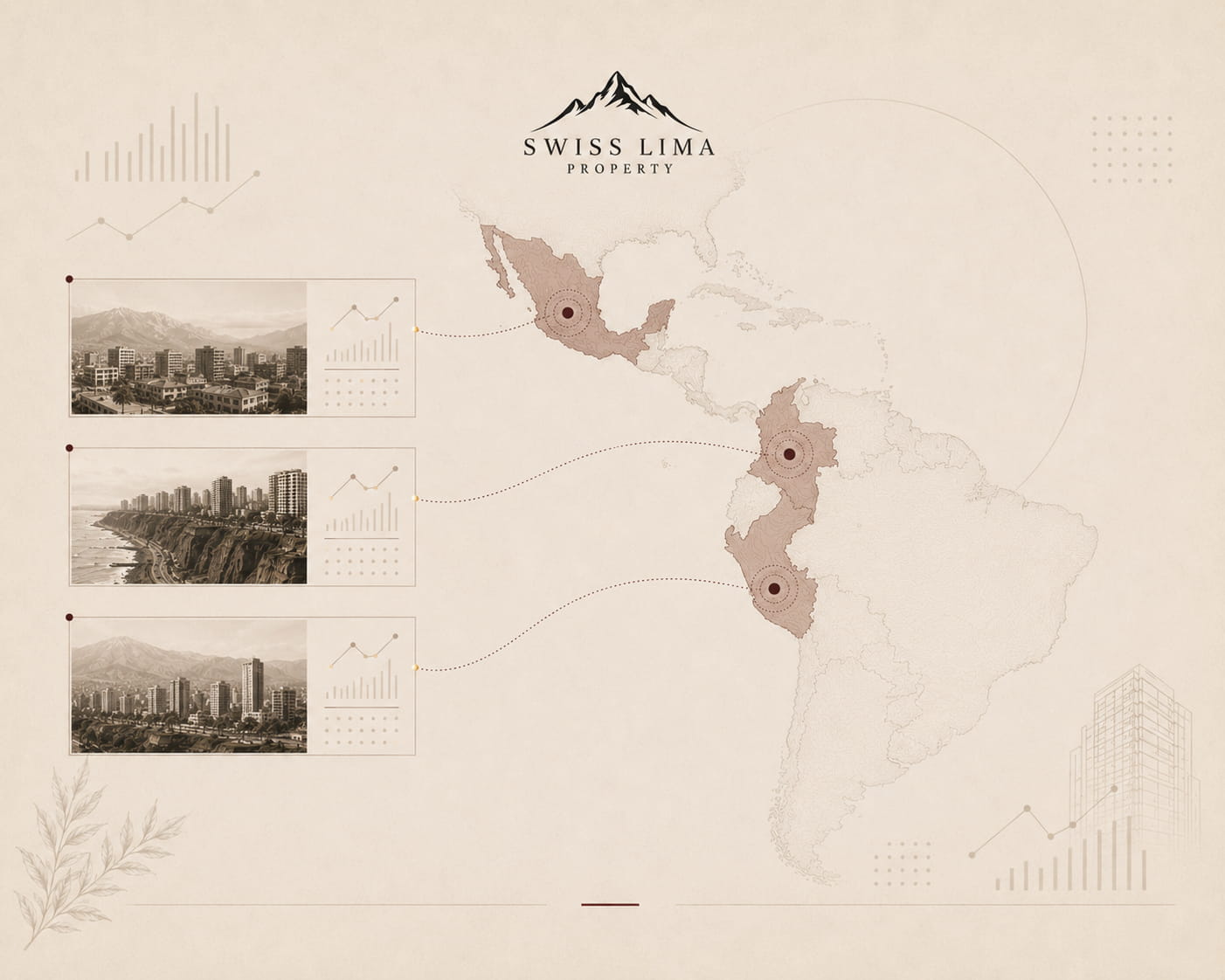
A few structural reference points (sources: World Bank 2024, IMF WEO 2025/2026):
- Peru: GDP ~USD 268B (World Bank 2024); GDP/capita ~USD 7,800; population ~33M. Lima Metropolitana ~10.1M inhabitants (29.7% of national population, INEI 2025), ~45% of national GDP. Economy driven by mineral exports — Peru ranks among the world's leading producers of copper, zinc, silver and gold (USGS Mineral Commodity Summaries 2024). GDP contracted slightly in 2023, rebounded to ~3% in 2024; IMF 2026 forecast ~2.8%.
- Colombia: GDP ~USD 363B (World Bank 2024); GDP/capita ~USD 7,100; population ~52M. One of Latin America's major economies, behind Brazil and Mexico, and in a range close to Argentina depending on the year. Diversified economy: oil, coffee, financial services, urban tourism.
- Mexico: GDP ~USD 1.3T (World Bank 2024); GDP/capita ~USD 10,200; population ~130M. Largest of the three; tightly integrated with the US economy; significant manufacturing, remittances, oil and tourism sectors.
Mexico is substantially larger and more liquid than Peru or Colombia. Colombia sits in between. Peru's smaller size does not mean lower opportunity — but it does mean a less liquid real estate market.
Property rights for foreigners
Peru: Article 71 of the Constitution grants foreign nationals the same property rights as Peruvian nationals. The sole restriction: property within 50 km of a land border requires special authorisation. Outside that zone, foreigners can own property outright with no additional conditions.
Colombia: Foreigners can own property in Colombia. There are no general constitutional restrictions equivalent to Mexico's restricted zones. Foreign real estate investment can be registered with the Banco de la República (Colombia's central bank), which facilitates repatriation of income and capital — applicable foreign exchange rules and registration requirements should be confirmed with a Colombian specialist. Verify current rules with a qualified local solicitor.
Mexico: More complex. Under Article 27 of the Mexican Constitution, foreigners cannot directly own property within 50 km of a coastline or 100 km of a land border ("restricted zones"). In these zones, the standard structure for residential foreign ownership is a fideicomiso (a bank trust held with a Mexican financial institution). A Mexican corporation is another possible route but not an automatic solution — the legal, fiscal and operational implications differ significantly depending on the structure chosen. Coastal resort destinations (Cancún, Los Cabos, Puerto Vallarta) all fall within restricted zones. Either structure adds legal cost and complexity compared to direct ownership.
Verify with a lawyer
Legal frameworks change. The above is an informational summary only. Consult a qualified local lawyer in each country before purchasing. This information must be verified before relying on it.
Real estate market overview
These are indicative figures from published third-party sources. They are subject to change and should be verified.
Peru (Lima):
- BCRP basket (12 districts): ~USD 2,009/m² (Q4 2025, BCRP); premium, new-build, well-located or view properties: ~USD 2,500–3,500/m² (GlobalPropertyGuide/BCRP)
- Indicative gross rental yields: ~5–7%, before tax, vacancy, management fees and maintenance — never guaranteed (GlobalPropertyGuide/Adondevivir)
- Market currency: predominantly USD in premium segments
Colombia (Bogotá, Medellín):
- Premium districts in Bogotá (Chicó, Rosales): ~USD 2,000–3,500/m² (indicative)
- Medellín has attracted significant remote-worker interest post-pandemic
- Gross rental yields: indicative ~5–7% in some segments — verify with current sources
- Market currency: Colombian peso (COP), adding FX risk for European investors
Mexico (Mexico City, coastal resorts):
- Mexico City premium (Polanco, Condesa): ~USD 2,000–4,000/m² (indicative)
- Coastal resorts (Tulum, Playa del Carmen, Los Cabos): prices vary widely; short-term rental market active but saturated in some areas
- Market currency: a mix of USD (resorts) and Mexican peso (MXN) in cities
These figures are indicative only. Verify with current market data before drawing conclusions.
Our speciality: Lima
Swiss Lima Property focuses exclusively on the Lima market — Miraflores, San Isidro, Barranco. If your thinking is moving towards Lima, our ground-level knowledge can save you time.
Fiscal considerations
Tax rules change — always verify
The following is a general orientation only and may be outdated. Tax treatment depends on your country of residence, applicable tax treaties and individual circumstances. Consult a tax professional in each country before investing.
Peru: For a non-domiciled individual, rental income from Peruvian real estate appears to be subject to a SUNAT withholding of approximately 5% (PPHND regime) rather than the standard 30% non-resident rate — confirm with a qualified Peruvian tax professional, as treatment may vary by transaction type. A double-taxation treaty between Peru and Switzerland has been in force since March 2014 — consult a Swiss or Peruvian fiscal specialist to assess its scope and application to your specific situation. Capital gains on property sales are also subject to Peruvian tax for non-residents.
Colombia: Colombia has a more developed tax treaty network than Peru. The exact treatment for Swiss or EU residents depends on applicable treaties — verify with a Colombian and home-country tax specialist.
Mexico: Mexico has double-taxation treaties with several European countries. Fideicomiso trust structures in restricted zones have specific fiscal implications. Verify with a Mexican tax lawyer.
Risk profile comparison
Political, macroeconomic and security risks are relevant to all three markets and change over time. Any summary is a snapshot.
- Peru: History of political instability at the executive level; relatively stable macroeconomy managed by independent BCRP; no armed internal conflict; lower crime rates in Lima tourist and expat zones than some regional comparisons suggest.
- Colombia: Made significant security progress since the 1990s–2000s; remaining narco-related violence concentrated in specific areas; Medellín has transformed significantly; Bogotá business environment is sophisticated. Political volatility exists.
- Mexico: Cartel violence is a real concern in multiple states; security situation varies dramatically by location (Mexico City's Condesa is very different from a border state); US economic integration adds both opportunity and exposure to US cycles.
Summary comparison table
Indicative comparison (verify before acting)
| Criterion | Peru | Colombia | Mexico |
|---|---|---|---|
| Foreign ownership (direct) | Yes (Art. 71) | Generally yes | Restricted zones: fideicomiso |
| Premium prices (indicative) | USD 2,500–3,500/m² | USD 2,000–3,500/m² | USD 2,000–4,000/m² |
| Gross yields (indicative) | ~5–7% indicative | ~5–7% (some segments) | Varies widely |
| Non-resident income tax | ~5% PPHND (rental — verify) | Verify with specialist | Verify with specialist |
| CH double-tax treaty | Yes (in force since 2014 — verify scope) | Verify | Yes (verify scope) |
| Market liquidity | Moderate | Moderate–good | Higher (larger market) |
All figures indicative. Verify before relying on them.
Which market for which investor?
No market is universally best. Some orientation:
- European investor focused on direct ownership, clear title, and no structural ownership complexity: Peru's Art. 71 framework offers simplicity that Mexico's fideicomiso requirement does not.
- Investor seeking a dynamic short-term rental market: Mexico's coastal resorts attract large tourist volumes but the market in some areas is crowded. Peru's Miraflores offers a growing long-term expat and professional rental market.
- Investor who values proximity to a large gateway economy: Mexico's US integration creates different dynamics from Peru's more self-contained market.
- Investor concerned about political stability: All three face political risk, though in different forms. Verify the current political climate at the time of investment.
This article does not constitute investment, tax or legal advice. Rules and market conditions change. Consult qualified specialists in each country before making any investment decision. Swiss Lima Property focuses on the Peruvian market and does not advise on Colombia or Mexico.