
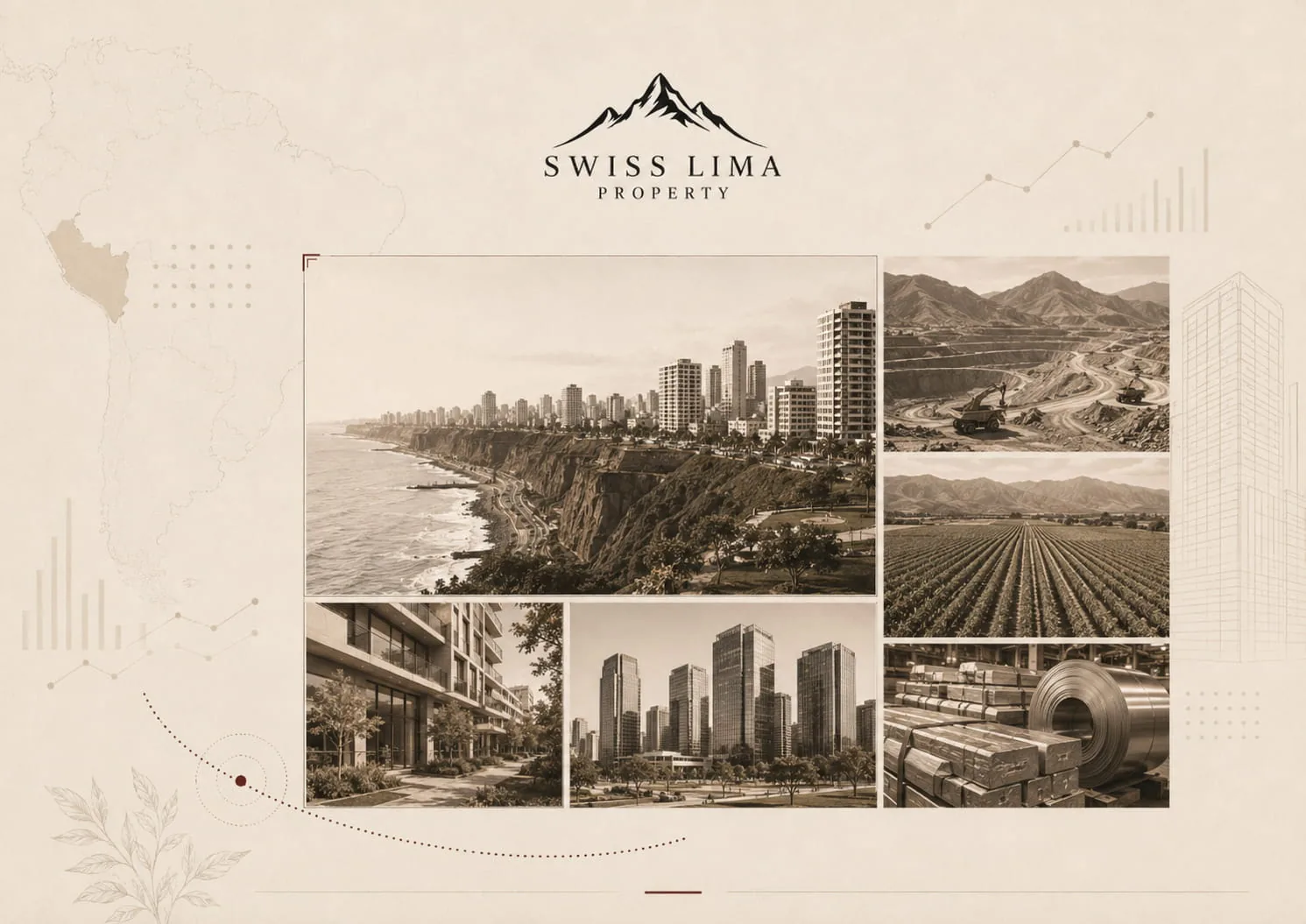
A subsoil among the richest in the world
In terms of natural resources, Peru has one of the richest subsoils in the world. According to data from the USGS (United States Geological Survey) and the Peruvian Ministry of Energy and Mines, the country ranks among the world's major producers of copper, zinc, silver and gold, with exact rankings varying by year and source:
- Copper, zinc, silver: among the world's top two or three producers depending on the year (USGS / MEM)
- Gold: among the world's top 10 producers
- Lead, tin, molybdenum: a significant presence in global rankings
Beyond mining, Peru has considerable agricultural resources. The world's second-largest producer of quinoa and a major exporter of asparagus, blueberries and coffee, the country benefits from a unique climatic diversity (desert coast, Andes, Amazon) that gives it diversified agricultural productivity. The fishing sector also accounts for a significant share of exports.
These resources generate currency flows that feed public finances, support the national currency, and constitute an indirect engine of the urban middle class, notably in Lima, where the head offices of mining companies and the associated services sector are concentrated.
GDP and economic growth
Peru's GDP was estimated at approximately USD 289 billion in 2024 according to World Bank data, placing the country among Latin America's intermediate economies, ahead of Chile in population but well below it in GDP per capita.
GDP per capita stood at approximately USD 8,450 in 2024 (World Bank data). This figure places Peru in the upper-middle-income category according to the World Bank classification, neither a poor country nor a developed one. Note: this figure corresponds to GDP per capita and should not be confused with GNI per capita measured using the Atlas method, which can differ.
In terms of growth, Peru has posted one of the most consistent performances in Latin America over the past 20 years. GDP grew by approximately +3.3% in 2024; recent forecasts for 2025-2026 generally sit around 2.7% to 3.4% depending on the international institution (World Bank / IMF), in a global context marked by uncertainty. This resilience is partly linked to export diversification and a prudent monetary policy from the Banco Central de Reserva del Perú.
HDI and inequality: the Peruvian complexity
Peru's Human Development Index (HDI), published by the UNDP in its 2025 report, was approximately 0.794 in 2023, placing the country in the "high human development" category. By comparison, Switzerland reaches 0.962 (very high category). Peru sits in the intermediate segment of Latin American countries on this indicator.
On the other hand, inequality remains significant. Peru's Gini index stood at around 40.2 in 2022 according to the World Bank, representing a moderate-to-high level of inequality on a global scale, although Peru is around the average for Latin America, a region traditionally marked by inequality.
The monetary poverty rate, calculated by INEI, was approximately 27.6% in 2024, then brought down to 25.7% in 2025, compared to 55% in 2005. The Covid-19 pandemic caused a temporary rebound, but the underlying trend over the past two decades remains downward.
The emergence of a middle class
The most structurally important economic fact for a real estate investor in Lima is perhaps the emergence of a significant middle class. According to INEI and World Bank estimates, this middle class represented approximately 34% of the Peruvian population in 2024, after a peak close to 40% in 2019 before the pandemic (compared to 25% in 2005).
This middle class (defined as households whose income places them above the poverty line and below the top decile) constitutes the demand for formal housing in Lima. It fuels new construction in intermediate districts (San Borja, San Luis, Surquillo), as well as rental demand in the premium districts of Miraflores and San Isidro, where many Peruvian professionals work.
This dynamic is favourable to long-term rental. It does not guarantee the profitability of a specific investment, but it constitutes a positive underlying context for rental demand.
Lima and the provinces: two realities
Peru is a deeply dual country. Lima Metropolitana concentrates approximately 29.7% of the national population (around 10.13 million inhabitants, INEI 2025) and produces approximately 45% of the country's total GDP. The Peruvian capital functions as an economy within the economy: its infrastructure, its range of services, its access to education and healthcare are of a quality with no equivalent in the Andean or Amazonian regions.
For a real estate investor, this reality is fundamental: an investment in Lima does not resemble an investment in the Andes or the Amazon. The formal real estate market accessible to foreigners is almost exclusively Lima-based. The price, yield and liquidity data cited in our guides therefore concern the Lima market, not Peru as a whole.
What this means for real estate investment
For a European investor, here is what Peru's economic structure concretely implies:
- A solvent demand exists: Lima's middle class constitutes a real pool of potential tenants and buyers. This is not an anecdotal market.
- The country is not poor: with an HDI of approximately 0.794 (UNDP 2025) and GDP per capita of approximately USD 8,450, Peru sits in a category of solid emerging economy, well above fragile states. But national statistics should not be confused with the Lima market.
- Inequality creates polarisation: Lima's real estate market is highly segmented. An apartment in Miraflores is not rented to the same tenants as an apartment in Villa El Salvador. This segmentation is a factor to integrate into the investment strategy.
- Dependence on commodities is a structural risk. Mining cycles influence state revenues, growth and indirectly employment in Lima. A prolonged fall in copper prices, for example, would affect Peruvian public finances.
Interested in real estate investment in Lima?
Swiss Lima Property helps European investors put this macro data into perspective for a concrete reflection on their project. Browse our selection of properties or let's discuss your approach together.
Risks and points of vigilance
Points of vigilance
- Dependence on mining cycles: a sustained fall in metal prices would affect state revenues and growth. This structural risk is real, even though Peru has diversified its economy over the past twenty years.
- Political instability: despite a resilient economy, Peru has experienced significant institutional instability since 2016. The political environment can affect investor confidence in the short term.
- Inequality and social tensions: persistent inequality regularly generates social conflicts, notably around mining projects. These tensions can affect the country's perception abroad.
- Do not confuse national growth with real estate performance: a growing economy does not guarantee rising property prices or rental yields. The two can diverge.
How Swiss Lima Property can support you
Understanding the Peruvian economy is a necessary but not sufficient step. Lima's real estate market has its own rules, segments, districts and players. Swiss Lima Property helps you put this macro data into perspective for a concrete reflection on your investment project.
We do not invent yields, we do not promise capital gains. We help you ask the right questions, meet the right local contacts, and move forward with your project seriously. Contact us to discuss it.