
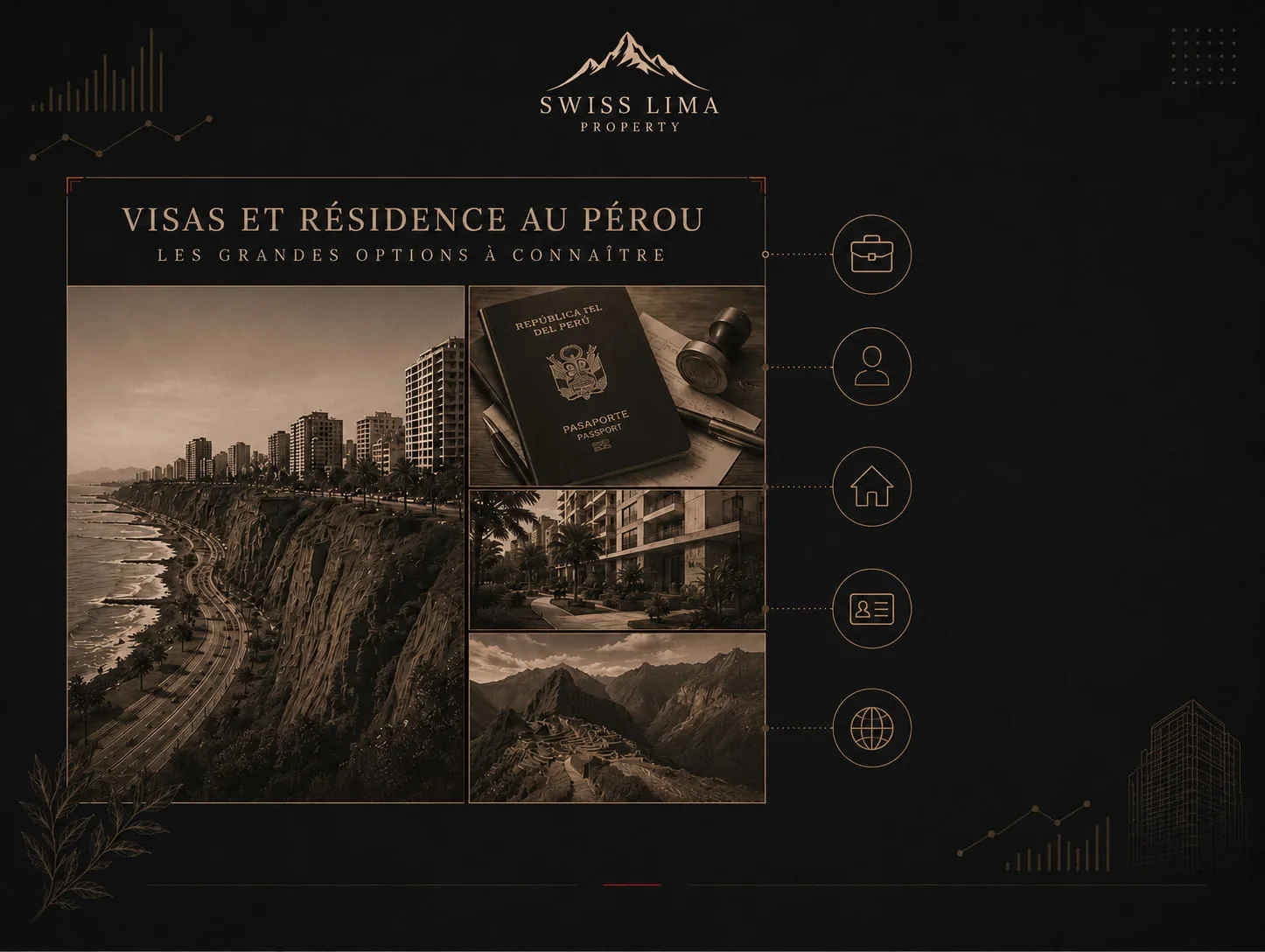
Residence and investment: two separate matters
One of the most common points of confusion in conversations about real estate investment in Peru is treating the purchase of a property as equivalent to obtaining a right of residence. This is not the case in Peru. A foreign national can perfectly well own an apartment in Lima, rent it out, receive rental income and manage the property remotely, without ever residing in Peru or holding resident status.
Conversely, residing in Peru does not necessarily require owning property there. These two dimensions, property ownership and immigration status, follow separate rules and are handled by different authorities: SUNARP and notaries for real estate, the Superintendencia Nacional de Migraciones for immigration.
This guide presents the main categories available, noting at each step that rules can change and must be verified against official sources.
The tourist visa
Swiss, European Union and many other nationals do not need a visa in advance to enter Peru as tourists. On arrival at the airport, an authorised stay is stamped into the passport, generally for 90 days. This can, in some cases, be extended for a further period, subject to conditions.
Tourist status does not permit:
- carrying out salaried work on Peruvian territory;
- receiving income from a commercial or professional activity conducted from Peru;
- accessing certain services reserved for residents.
On the other hand, tourist status does allow a foreign national to buy a property before a Peruvian notary, obtain a RUC (tax number) from SUNAT, and carry out routine administrative procedures.
For investors who wish to visit Peru occasionally to view properties, sign notarial deeds or follow up on their investment, tourist status is generally sufficient for short stays. However, some Peruvian notaries may require a special Migraciones permit to sign documents or contracts (gob.pe/12614) depending on the buyer's migration status; verify this with the chosen notary before the signing date. For a longer-term stay, a residence status is required.
Temporary and permanent residence
The Superintendencia Nacional de Migraciones (Migraciones) manages all immigration statuses in Peru. The country distinguishes two broad categories: temporary residence, granted for one year and renewable, and permanent residence, accessible after several years of temporary residence or directly in certain specific cases (marriage to a Peruvian national, direct family ties, etc.).
The main temporary residence categories available to a foreign national are:
- Salaried worker residence: requires an employment contract with a Peruvian employer;
- Family residence: for spouses, children or parents of a Peruvian national or permanent resident;
- Student residence: tied to enrolment at a recognised Peruvian educational institution;
- Investor residence: for foreign nationals making productive investments in Peru;
- Rentista residence: for individuals with regular passive income.
Each category has its own conditions, timelines and required documents. Official, up-to-date information is available on the Migraciones portal.
The investor visa
Peru has a specific immigration category for investors: the Calidad Migratoria Inversionista. This category requires a certified productive investment of at least S/.500,000 (approximately 130,000 to 135,000 USD at typical exchange rates) in a Peruvian-registered entity or formally approved productive activity.
A critical point that is frequently overlooked: the purchase of real estate in Peru does not qualify as a productive investment for the purposes of this investor visa, according to the Peruvian immigration authority's interpretation. The investment must be in a company or productive economic activity, not simply in property.
Obtaining this visa requires detailed documentation: proof of the investment, company registration, SUNAT tax registration, and legal opinion from a qualified attorney. Processing is complex and should not be attempted without professional legal support.
The work visa
To carry out salaried work in Peru, a foreign national must hold a work visa, generally tied to a contract with a Peruvian employer. Peruvian regulations set specific rules on the maximum proportion of foreign employees within a Peruvian company.
This status does not directly concern foreign real estate investors based in Europe who manage their property remotely. It is mentioned here to clear up a frequent confusion: receiving rent from an apartment in Lima is not considered a professional activity requiring a work visa, but it can create tax obligations with SUNAT.
Residence through income (Rentista)
The "rentista" residence category allows a foreign national with sufficient, regular passive income (pensions, investment income, annuities, dividends) to obtain temporary residence in Peru. This category can be relevant for a European retiree wishing to spend several months a year in Lima.
The precise conditions (minimum income amount, accepted types of income, documents to provide) are set by Migraciones and must be verified on the official portal or with a specialised lawyer. These conditions can change from one year to the next.
Property purchase and residence: not to be confused
This point is worth repeating clearly, as the confusion is common: buying a property in Peru does not automatically confer a right of residence.
Article 71 of the Peruvian Constitution guarantees foreign nationals the same property rights as Peruvian citizens, with no prior residence requirement. A Swiss investor can buy an apartment in Miraflores, register the title at SUNARP, receive rent through a local manager, and never reside in Peru. These two matters (ownership and residence) are legally independent.
On the other hand, if you plan to receive rental income of Peruvian source, you will have tax obligations with SUNAT, regardless of your immigration status. These obligations are separate from the question of residence.
Important warning
- This guide does not constitute personalised immigration advice. Peruvian immigration rules can change quickly.
- Any visa or residence application must be prepared with a lawyer qualified in Peruvian immigration law.
- Current official information is published on the Migraciones portal (migraciones.gob.pe) and on Peruvian consulate websites.
- Swiss Lima Property is not a law firm and does not provide immigration advice. We can refer you to qualified local professionals.
Documents to prepare
Whatever immigration status is being considered, a foreign investor wishing to get involved in Peru must ensure they have or can obtain the following:
- Valid passport with sufficient remaining validity (generally at least 6 months beyond the planned stay);
- RUC (Registro Único de Contribuyentes): Peruvian tax identification number. A foreign buyer may need to obtain one depending on the transaction, their tax status and obligations linked to renting or reselling; confirm with SUNAT, the notary or a Peruvian lawyer;
- Peruvian bank account: not mandatory for real estate transactions, but strongly recommended to facilitate local procedures and bancarización obligations (traceability of funds);
- Address in Peru: needed for any local administrative procedure (SUNAT, notaries, etc.).
For a residence application, additional documents will be required depending on the category: criminal record certificate, proof of income, apostilled and translated civil status documents, ID photos. Consult Migraciones for the exhaustive, up-to-date list.