
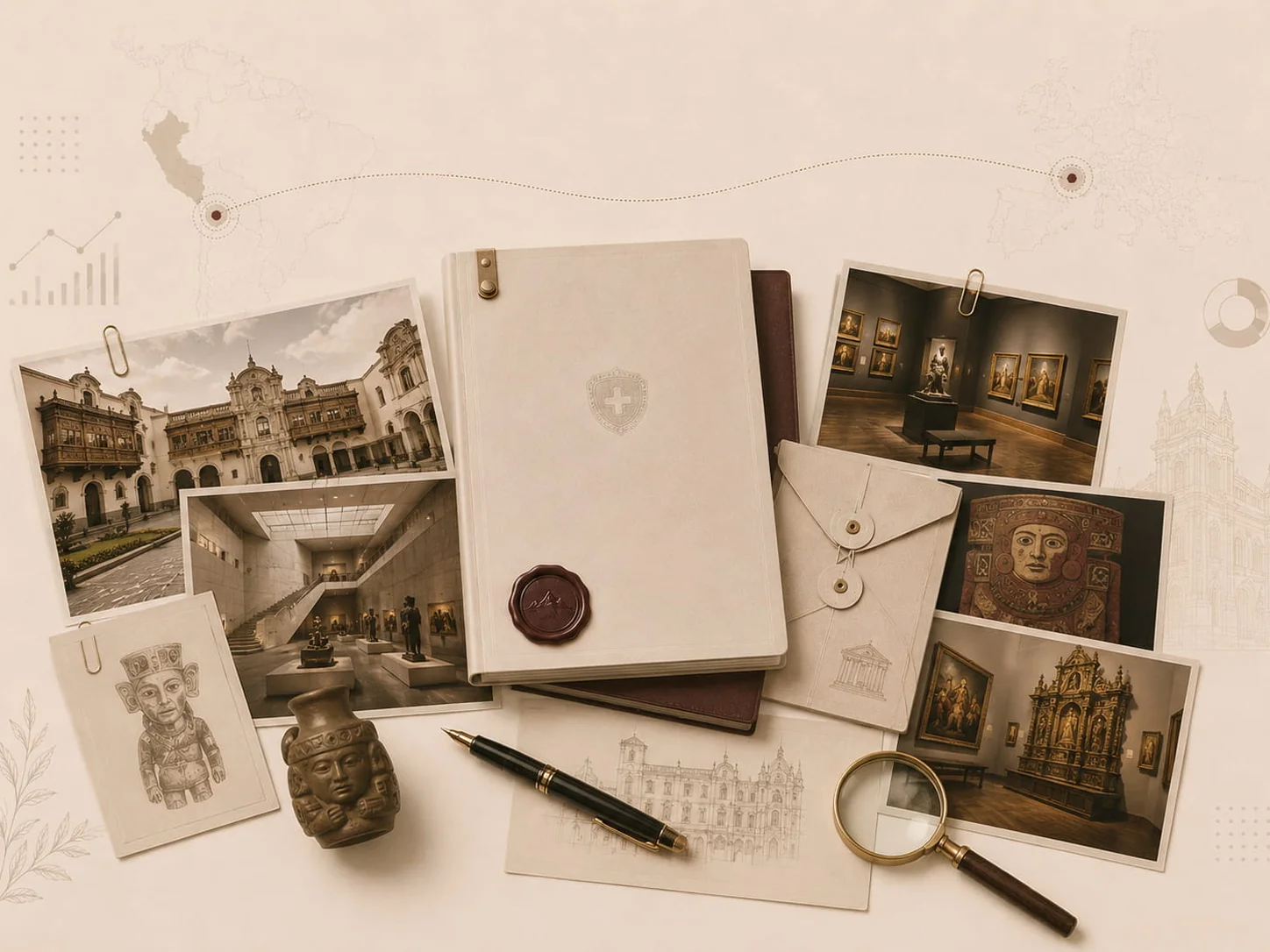
Why visit the museums of Lima?
Most travellers arriving in Lima are already thinking about what comes next: Cusco, Machu Picchu, Arequipa or the Amazon. It's an understandable reaction, but it often deprives the trip of an essential stage. Before discovering the civilisations that shaped the Andes or the southern coast, Lima helps you understand their foundations.
The capital concentrates several first-rate museum institutions, spread across very different districts: Pueblo Libre for archaeology, Miraflores for textiles and contemporary memory, Barranco for colonial art, the historic centre for religious and institutional heritage. This geographic spread reflects, in its own way, the diversity of the country itself.
Visiting these museums before heading to the rest of Peru changes the way you look at what follows. A Moche ceramic seen at Museo Larco, a pre-Columbian weaving examined at Museo Amano, or a piece of metalwork displayed at the National Museum provide context that resurfaces later at Chan Chan, at Chavín de Huántar, or in front of the textiles sold in Chinchero. Archaeology, colonial art, gastronomy and the country's recent history illuminate each other in these rooms.
The mistake to avoid
Don't treat Lima merely as a logistical stopover. One or two well-organised days in its museums can deeply enrich the rest of your trip through Peru.
Lima's museums also serve a more practical purpose: they offer a valuable alternative when the sky stays grey under the winter garúa, or simply when you want to slow the pace of a trip. They also let you discover districts you might otherwise rarely visit for their own sake, such as Pueblo Libre, alongside must-sees like Miraflores, Barranco or the historic centre.
This cultural dimension complements the major stops covered in our guide on essential places to see in Peru, as well as the geographic overview in our guide on Peru's three regions. To time these visits well, our guide on when to visit Peru remains a useful reference.
How to choose which museums to visit in Lima?
Not all of Lima's museums serve the same purpose. Some illuminate pre-Hispanic civilisations, others colonial or republican art, others still the country's contemporary memory. The groupings below help narrow down a first choice based on what you want to understand.
To understand ancient Peru
- Museo Larco
- National Museum (MNAAHP)
- Museo Amano
- Huaca Pucllana
For Peruvian art
- MALI
- Museo Pedro de Osma
- MUCEN
- Galleries, depending on programme
To understand Lima
- Huaca Pucllana
- MALI
- Casa de Aliaga
- San Francisco, historic centre, LUM
For a short first visit
- Museo Larco
- Huaca Pucllana
- MALI or Pedro de Osma, depending on district
- San Francisco if passing through the centre
For a longer stay
- MNAAHP, Museo Amano, LUM
- MUCEN, Casa de Aliaga
- Neighbourhood museums and temporary exhibitions
Practical tip
Organise your visits by district. Lima is large and travel times can be significant. It's better to group the museums of Pueblo Libre, Miraflores, Barranco or the historic centre than to cross the city several times in the same day.
Museo Larco: understanding pre-Hispanic Peru
Set in Pueblo Libre inside an 18th-century viceroyal mansion surrounded by gardens, Museo Larco is often the most educational entry point for approaching Peru's pre-Columbian civilisations. Its collection, assembled from 1926 onward, spans several millennia of history through ceramics, textiles, metalwork and ritual objects.
The tour gives a central place to the Moche, Chimú, Nazca, Wari and Chancay cultures, among other coastal and Andean traditions. The very careful presentation traces the evolution of ceramic techniques, belief systems and the social organisation of these societies well before the arrival of the Incas. The museum also keeps a visible storage gallery, which gives a sense of the true scale of the collection beyond the permanent exhibition rooms.
The museum also presents, in a separate space, a collection devoted to sexual imagery in pre-Columbian art. This part of the visit is treated with the same ethnographic seriousness as the rest of the tour: it documents the place of sexuality, fertility and ritual in ancient Andean societies, rather than reducing it to a passing curiosity.
The garden, courtyards and restaurant make it a pleasant visit beyond the exhibition rooms themselves, particularly in the late afternoon.
Why start with Museo Larco?
Because it shows that pre-Hispanic Peru is not limited to the Incas. The Moche, Nazca, Chimú, Wari and other traditions hold an essential place in the country's history.
Practical information, to be confirmed before your visit:
- District: Pueblo Libre
- Suggested duration: 1.5 to 2.5 hours
- Best for: first visit, archaeology, pre-Hispanic history, families, curious travellers
- To check: hours and admission fees on the official website
Museo de Arte de Lima — MALI
The Museo de Arte de Lima occupies the former Palacio de la Exposición, a historic building in the Parque de la Exposición, between the historic centre and the more modern districts of the capital. It is one of the most important institutions for understanding Peruvian art over time.
Its collections and exhibitions cover different periods of the country's creative history: pre-Hispanic, colonial, republican, modern or contemporary art, depending on the rooms and current exhibitions. This continuity between history, territory and artistic creation is precisely what makes the visit worthwhile, even for a visitor unfamiliar with Peruvian art.
MALI holds a central place in Lima's cultural scene, with a regular programme of temporary exhibitions. As these change constantly, this guide deliberately avoids detailing any of them: it's best to check the official programme before visiting.
Combine it with central Lima
MALI sits in a convenient area for a cultural day combining the Parque de la Exposición, the historic centre, MUCEN, San Francisco or other heritage sites.
Practical information, to be confirmed before your visit:
- District: Cercado de Lima / Parque de la Exposición
- Suggested duration: 1.5 to 2.5 hours
- Best for: Peruvian art, visual history, exhibitions, architecture
- To check: hours, tickets and exhibitions on the official website
Museo de Sitio Pucllana and the Huaca Pucllana
Few capital cities offer a major archaeological site in the heart of a modern residential district. Yet that's exactly the case in Miraflores, where the Huaca Pucllana rises among the apartment buildings, just a few streets from the Malecón. This ceremonial adobe complex, attributed to the Lima culture, which predates the Incas by several centuries, deserves to be seen as far more than a curiosity in the middle of the city.
The site is visited with a guide, as part of a site museum that presents the excavations, adobe construction techniques and discoveries made since the research programme began. The contrast between these ancient remains and the contemporary city surrounding them gives a tangible sense of the historical depth of Peru's central coast, well before the arrival of the Spanish and even before the Inca Empire.
For a traveller staying in Miraflores, Huaca Pucllana is often the simplest and quickest entry point into Lima's pre-Hispanic history.
Why it's a must in Miraflores
Few capital cities let you visit a major archaeological site in the heart of a modern residential district. Huaca Pucllana shows that Lima existed as a cultural territory long before the colonial city.
Practical information, to be confirmed before your visit:
- District: Miraflores
- Suggested duration: 1 to 1.5 hours
- Best for: first visit, families, archaeology, staying in Miraflores
- To check: opening days, day or evening visits, booking and fees on the official source
National Museum of Archaeology, Anthropology and History of Peru
Also located in Pueblo Libre, close to Museo Larco, the National Museum of Archaeology, Anthropology and History of Peru (MNAAHP) is one of the country's oldest museum institutions, founded in the 19th century as part of an effort to build a national identity. Its collection covers the entire span of human occupation of Peruvian territory, from pre-ceramic periods to the republican era.
The approach here is more institutional than at Museo Larco: less staged, but valuable for anyone wishing to go deeper into the country's archaeology, anthropology and history over the long term. It works well as a natural complement to a first visit already made at Museo Larco, rather than as a starting point for a traveller in a hurry.
Museo Larco or the National Museum?
Museo Larco is often more accessible for a smooth first visit. The National Museum is worthwhile for going deeper into the country's history in a more institutional setting. The two can complement each other well, especially if you're staying in Pueblo Libre or planning a more culturally focused trip.
Practical information, to be confirmed before your visit:
- District: Pueblo Libre
- Suggested duration: 1.5 to 2.5 hours
- Best for: history, archaeology, anthropology, curious travellers
- To check: hours, access and visiting conditions on the official website
Museo Pedro de Osma in Barranco
Housed in a former residence in Barranco, the Museo Pedro de Osma holds one of Peru's most important collections of viceroyal art: paintings, sculptures, religious objects, furniture and decorative arts from the colonial era. The visit takes place in a heritage setting that highlights the collection almost as much as the works themselves.
This dialogue between built heritage, architecture and collection makes it a particularly rewarding visit for anyone interested in colonial art, which is often given less attention than pre-Hispanic art in major tourist itineraries.
Why visit it in Barranco?
Barranco is often associated with cafés, galleries, restaurants and a bohemian atmosphere. The Museo Pedro de Osma adds a heritage and historical dimension to exploring the district.
Practical information, to be confirmed before your visit:
- District: Barranco
- Suggested duration: 1 to 1.5 hours
- Best for: colonial art, architecture, Barranco, heritage-minded visitors
- To check: hours, tickets and exhibitions on the official website
Museo Amano: pre-Columbian textiles in Miraflores
Quieter than Museo Larco or MALI, the Museo Amano, in Miraflores, is devoted to pre-Columbian textiles. Its collection, assembled from the 1960s onward, presents the techniques, motifs, colours and materials used by several ancient Peruvian cultures, including the Chavín, Paracas, Moche, Nazca, Wari, Lambayeque, Chimú and Chancay traditions.
This museum is particularly relevant for visitors interested in textiles, design, craftsmanship, material culture or ancient art more broadly. It helps explore a dimension of pre-Hispanic art that is often underestimated, less immediately striking than metalwork or ceramics, but just as revealing of how these societies were organised.
Textiles as a language
In ancient Peru, textiles were not simple decorative objects. They could convey status, techniques, symbols and a worldview. Museo Amano allows visitors to approach this dimension with more precision.
Practical information, to be confirmed before your visit:
- District: Miraflores
- Suggested duration: 1 to 1.5 hours
- Best for: textiles, design, pre-Columbian history, curious travellers
- To check: hours, fees and guided tours on the official website
LUM: memory, tolerance and contemporary history
The Lugar de la Memoria, la Tolerancia y la Inclusión Social, better known by its acronym LUM, occupies a distinct place in this guide. Located in Miraflores, overlooking the coastline, this space is dedicated to the memory of the period of violence Peru experienced between 1980 and 2000. It is not an art or archaeology museum, but a place of reflection, education and remembrance.
The visit is necessarily different from that of an art museum or an archaeological site: it invites visitors to understand a painful and complex period in the country's recent history, as well as the way a society builds its collective memory in the face of violence. The LUM welcomes the diversity of voices and experiences tied to this period, without reducing the subject to a single reading.
For a visitor wishing to understand contemporary Peru beyond its tourist sites, this visit offers insight that few other places in Lima provide.
An important, but different, visit
The LUM is not visited to admire ancient objects or decorative works. It instead invites visitors to understand a painful period in the country's recent history and the way a society builds its memory.
Practical information, to be confirmed before your visit:
- District: Miraflores
- Suggested duration: 1 to 2 hours
- Best for: contemporary history, memory, Peruvian society, visitors wishing to understand the country beyond tourism
- To check: hours, access and any guided tours on the official website
MUCEN: art, currency and heritage in central Lima
MUCEN, the museum of the Banco Central de Reserva del Perú, occupies a former bank building in the historic centre. It's a museum often underestimated by travellers, even though its collection covers archaeology, republican painting, traditional popular art and the country's monetary history.
This range of themes, brought together in a single institutional building, makes it a good option for rounding out a day in the historic centre, particularly for visitors interested in economic history, heritage objects and the role of institutions in cultural preservation.
For finance and history-minded profiles
MUCEN may particularly appeal to visitors interested in monetary history, heritage objects, economic exchange and the role institutions play in cultural preservation.
Practical information, to be confirmed before your visit:
- District: historic centre / Cercado de Lima
- Suggested duration: 45 minutes to 1.5 hours
- Best for: art, currency, history, curious travellers, historic centre
- To check: hours and access conditions on the official website
Museo Convento San Francisco and the catacombs
The San Francisco religious complex, construction of which began in the mid-16th century, remains one of the most visited sites in Lima's historic centre. The convent preserves remarkable colonial architecture, cloisters decorated with azulejo tiles, an ancient library holding several thousand volumes, and a collection of religious paintings and sculptures.
Beneath the convent lie catacombs that served as a burial site during the colonial period. This guide presents them without sensationalism: it is a historic funerary space, included as part of the guided tour of the complex, rather than an attraction to be treated as a spectacle.
A classic of the historic centre
San Francisco reveals another side of Lima: the colonial, religious, architectural and underground city. It pairs very well with a visit to the Plaza Mayor, the cathedral and the streets of the centre.
Practical information, to be confirmed before your visit:
- District: historic centre
- Suggested duration: 1 to 1.5 hours
- Best for: colonial architecture, religious history, historic centre
- To check: hours, fees and guided tours from the official source
Casa de Aliaga and Lima's historic residences
A short walk from the Plaza Mayor, Casa de Aliaga is one of Lima's best-known historic residences, occupied by the same family since the earliest decades of the colonial city. It is not a classic museum with neutral exhibition rooms: it is a lived-in residence, transformed and preserved over several centuries, visited as part of a guided tour.
Reception rooms, courtyards, antique furniture and elements of colonial and republican architecture follow one another, offering a glimpse of aristocratic Lima as it evolved across generations. This type of visit complements the institutional museums of the historic centre well, adding a more intimate dimension to discovering colonial heritage.
Museum or heritage residence?
Casa de Aliaga is not a classic museum with neutral exhibition rooms. It is a historic residence that lets you feel Lima's evolution through a lived-in space, transformed and preserved over several centuries.
Practical information, to be confirmed before your visit:
- District: historic centre
- Suggested duration: 45 minutes to 1 hour
- Best for: architecture, colonial heritage, historic centre
- To check: hours, booking and visiting conditions on the official website; a guided tour is generally required
Other museums and cultural sites worth considering
Beyond the places already covered, Lima has other institutions worth considering depending on the time available and the programme running during your stay.
Museo de Arte Contemporáneo — MAC Lima
Located in Barranco, MAC presents temporary exhibitions of Peruvian and international contemporary art. A good option for visitors interested in the current art scene, easily combined with the rest of the district.
Museo de la Catedral de Lima
Adjoining the cathedral on the Plaza Mayor, this museum presents religious art, altarpieces and a crypt where several archbishops of Lima are buried. A natural addition for anyone already exploring the historic centre.
Museo de Sitio Bodega y Quadra
Set in the historic centre on an urban archaeological site uncovered during works, this small museum presents several layers of the city's occupation, from the colonial era to the republican period.
Museo Metropolitano de Lima
This audiovisual museum, located in the Parque de la Exposición, offers an immersive journey through the city's pre-Hispanic, viceroyal and republican history, with a more technological format than classic museums.
Galleries and cultural centres
Beyond the major museums, Miraflores, Barranco and San Isidro host an active scene of galleries and cultural centres with temporary exhibitions, worth checking depending on the current programme.
Programming, opening hours and even the operating status of some smaller venues can change. Always verify a site is open before adding it to your itinerary.
Which museums should you visit based on your interests?
Priorities differ depending on the length of your stay, the district you're staying in and your interests. The groupings below can help guide a first choice.
First visit to Lima
- Museo Larco
- Huaca Pucllana
- MALI or San Francisco, depending on district
Pre-Hispanic Peru
- Museo Larco
- MNAAHP
- Museo Amano
- Huaca Pucllana
A day in Miraflores
- Huaca Pucllana
- Museo Amano
- LUM
- Walk along the Malecón
A day in Barranco
- Museo Pedro de Osma
- MAC, if open
- Galleries and district architecture
A day in the historic centre
- San Francisco
- MUCEN
- Casa de Aliaga
- Cathedral, depending on hours
Art enthusiasts
- MALI
- Pedro de Osma
- MAC
- MUCEN, galleries
Families
- Museo Larco
- Huaca Pucllana
- MUCEN
- MALI, depending on exhibition
Expats or future residents
- Museo Larco, LUM, MALI
- Neighbourhood museums
- Temporary exhibitions over time
Looking to get to know Lima over time?
Swiss Lima Property supports Swiss and European nationals who want to understand Lima in depth, whether for an extended stay or a relocation project. Our guides on districts and life in Lima usefully complement this cultural exploration.
Museum itineraries in Lima based on your available time
These suggestions remain indicative: travel times in Lima can be significant and should always be factored into your planning.
If you have half a day
- Option 1: Museo Larco in Pueblo Libre.
- Option 2: Huaca Pucllana, then a walk around Miraflores.
- Option 3: San Francisco and MUCEN in the historic centre.
If you have a full day
Classic cultural option: Museo Larco in the morning, lunch in Pueblo Libre or Miraflores, then Huaca Pucllana or MALI in the afternoon.
Historic centre option: San Francisco, MUCEN, Casa de Aliaga and the Plaza Mayor, with a lunch break in the centre.
Miraflores, memory and textiles option: Huaca Pucllana, Museo Amano, LUM, then the Malecón at the end of the day.
If you have two days
Day 1, Pueblo Libre and Miraflores: Museo Larco, MNAAHP, then Huaca Pucllana or Museo Amano.
Day 2, Barranco and the historic centre: Museo Pedro de Osma, MALI, then San Francisco or MUCEN.
If you're living in Lima for several weeks
It's best to visit the major museums progressively, then explore temporary exhibitions, galleries, cultural centres and lesser-known museums, possibly through guided neighbourhood tours.
Travel times in Lima need to be taken into account. It's better to plan fewer visits and enjoy them more.
Summary table of museums
This table summarises, for reference, the main sites covered in this guide. It is not a ranking: each site has its own value depending on the visitor's profile and available time.
| Museum or site | District | Main theme | Suggested duration | Best for | To check |
|---|---|---|---|---|---|
| Museo Larco | Pueblo Libre | Pre-Columbian archaeology | 1.5 to 2.5h | First visit | Hours, fees |
| MALI | Parque de la Exposición | Peruvian art | 1.5 to 2.5h | Art, exhibitions | Exhibitions, tickets |
| Huaca Pucllana | Miraflores | Pre-Hispanic site | 1 to 1.5h | Families, archaeology | Days, booking |
| MNAAHP | Pueblo Libre | Archaeology, anthropology | 1.5 to 2.5h | Going deeper | Hours, access |
| Museo Pedro de Osma | Barranco | Colonial art | 1 to 1.5h | Heritage, architecture | Hours, tickets |
| Museo Amano | Miraflores | Pre-Columbian textiles | 1 to 1.5h | Textiles, design | Hours, guided tours |
| LUM | Miraflores | Contemporary memory | 1 to 2h | Recent history | Hours, access |
| MUCEN | Historic centre | Art, currency, heritage | 45 min to 1.5h | History, economics | Access hours |
| San Francisco & catacombs | Historic centre | Architecture, religion | 1 to 1.5h | Colonial heritage | Hours, guided tours |
| Casa de Aliaga | Historic centre | Historic residence | 45 min to 1h | Architecture, heritage | Booking |
| MAC Lima | Barranco | Contemporary art | 1 to 1.5h | Current art scene | Programme, hours |
| Museo de la Catedral | Historic centre | Religious art | 45 min to 1h | Plaza Mayor, heritage | Hours |
| Bodega y Quadra | Historic centre | Urban archaeology | 30 to 45 min | Local history buffs | Hours |
Practical tips before visiting
Check official opening hours
Hours can change on public holidays, during works, private events or programme changes.
Book ahead when necessary
Some sites, historic houses or guided tours may require booking, sometimes mandatory, as is the case at Casa de Aliaga.
Group your visits by district
Pueblo Libre, Miraflores, Barranco and the historic centre should be treated as distinct zones, not combined within the same half-day.
Plan your travel time
Use a reliable transport app or a trusted driver, depending on the district and the time of day.
Leave some margin
Don't stack too many museums into a single day: fatigue undermines the quality of the cultural experience.
Check the language of tours
Some guided tours may only be offered in Spanish. Check for English options or the availability of audio guides.
Respect photography rules
Some museums restrict photos, flash, video or professional filming. These rules must be respected on site.
Adapt the visit for children
Some museums, such as Museo Larco or Huaca Pucllana, are more accessible for families than others, such as the LUM.
Don't overlook the lesser-known museums
Some less-visited sites, such as MUCEN or Bodega y Quadra, can be very rewarding, often with fewer crowds.
Plan a visit even on a grey day
Lima's coastal winter, marked by the garúa, makes museums particularly enjoyable when the sky is overcast. Our guide on when to visit Peru details these seasonal trends.
Key takeaways
- Lima holds some of the most important museums in Peru.
- Museo Larco is often the best starting point for understanding pre-Hispanic Peru.
- Huaca Pucllana shows Lima's ancient history at the heart of Miraflores.
- MALI offers a way to explore Peruvian art over time.
- Pueblo Libre is an essential district for history enthusiasts.
- Barranco offers a fine combination of art, heritage and strolling.
- The historic centre brings together several major sites such as San Francisco, MUCEN and Casa de Aliaga.
- The LUM helps you understand an important part of Peru's contemporary history.
- Hours and fees should always be verified on official websites.
- It's better to organise visits by district rather than multiplying trips across the city.
Frequently asked questions
Planning a trip?
SwissLima, our Peru travel guide, compares Lima's museums by collection, duration and price. Read more: Which museum to visit in Lima?.
What are the essential museums to visit in Lima?
Museo Larco, MALI, Huaca Pucllana, Museo Pedro de Osma and Museo Amano form the core of a cultural exploration of Lima. Depending on the time available, the MNAAHP, LUM, MUCEN, San Francisco and Casa de Aliaga usefully round out this selection.
Which museum should you visit first in Lima?
Museo Larco, in Pueblo Libre, is generally the most educational starting point for understanding the country's pre-Columbian civilisations before continuing your trip to Cusco or the archaeological north.
Is Museo Larco worth the visit?
Yes. Its educational presentation, the richness of its collection and its garden make it one of Lima's most appreciated museums, particularly for a first approach to pre-Columbian Peruvian cultures.
Can you visit Huaca Pucllana without a guide?
The site generally operates with guided tours included in the admission ticket, which helps visitors better understand the adobe construction techniques and the history of the Lima culture. Exact conditions should be checked on site or with the official source.
Which museums should you visit in Miraflores?
Huaca Pucllana, Museo Amano and the LUM are the three major cultural sites in Miraflores, each covering a different aspect: archaeology, pre-Columbian textiles and contemporary memory.
Which museums should you visit in Barranco?
Museo Pedro de Osma, dedicated to viceroyal art, remains the district's benchmark. MAC Lima, devoted to contemporary art, usefully rounds out the visit depending on the current programme.
Which museums should you visit in Lima's historic centre?
Museo Convento San Francisco and its catacombs, MUCEN and Casa de Aliaga are the main cultural sites in the historic centre, all within easy walking distance of the Plaza Mayor and the cathedral.
Which museum should you choose to understand pre-Hispanic Peru?
Museo Larco offers the most educational approach. The MNAAHP allows for a deeper look in a more institutional setting, while Museo Amano focuses specifically on ancient textiles.
Which museum should you visit with children in Lima?
Museo Larco, Huaca Pucllana and MUCEN are generally well suited to families. The LUM, given the nature of the subject it addresses, is better suited to older visitors.
Are Lima's museums open on Mondays?
This depends on each institution: several museums in Lima close on Mondays, others do not. Opening days and hours should always be checked on each museum's official website before visiting.
Do you need to book museums in Lima in advance?
This varies by site. Some historic residences, such as Casa de Aliaga, operate only through guided tours that must be booked. Other museums, such as Museo Larco or MALI, can generally be visited without prior booking, though booking online is recommended during peak season.
How much time should you allow for visiting Lima's museums?
Allow half a day for an in-depth museum such as Museo Larco, a full day to combine two or three sites within the same district, and two days to cover the main museums across several districts.
Are Lima's museums free to visit?
This depends on the museum: some, such as MUCEN, follow a very accessible admission policy, while others, such as Museo Larco or Museo Pedro de Osma, charge an entrance fee. Exact fees should be checked on each official website, as they change regularly.
Can you take photos inside Lima's museums?
Rules vary by institution and by room: some allow photography without flash, others restrict it entirely, particularly in front of certain religious works or fragile pieces. These rules must be respected on site.