
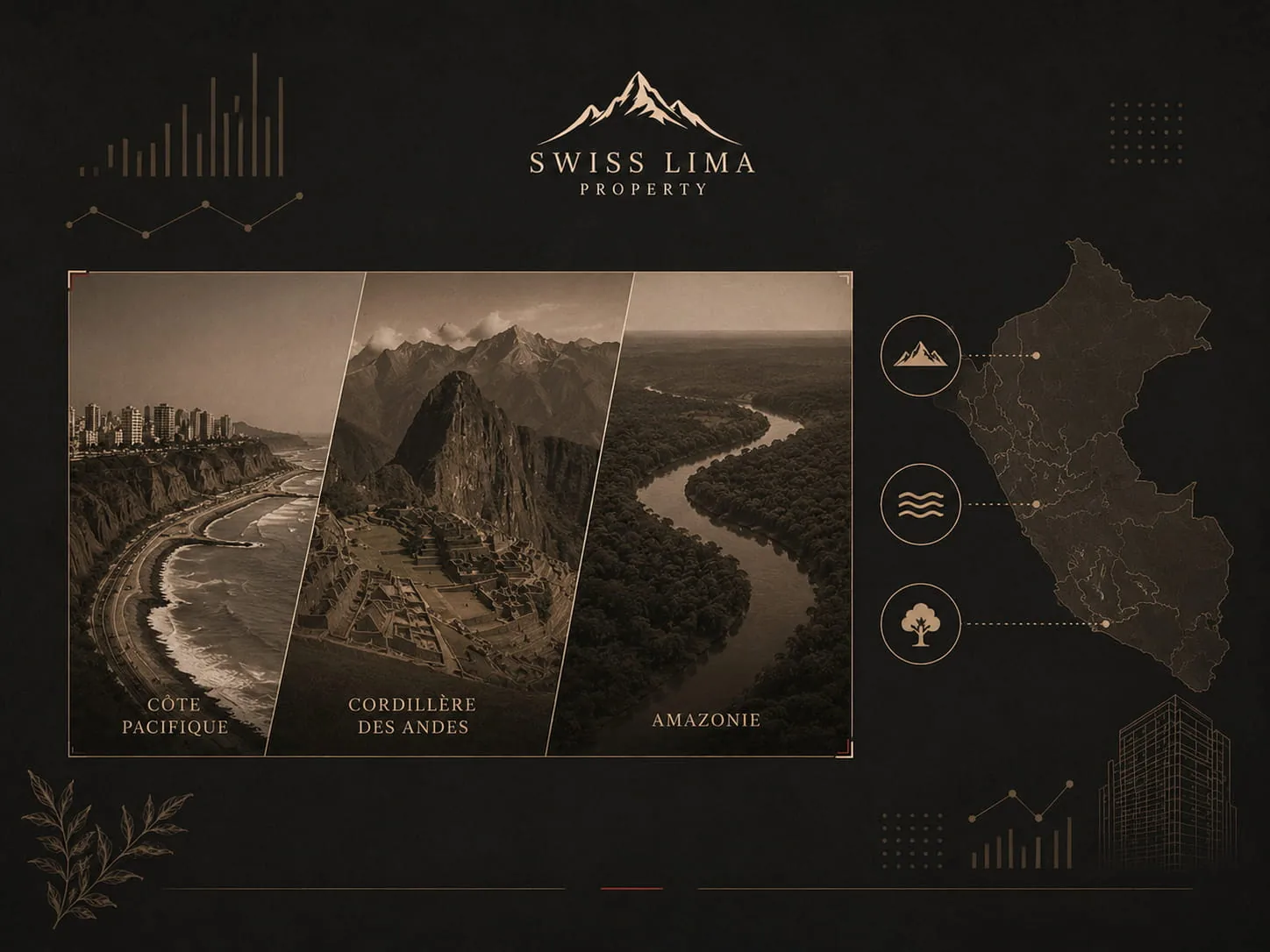
A country of three faces
Peru is often described as a destination, a market, an emerging country. But geographically, it brings together such contrasting realities that it is almost impossible to speak of Peru as a uniform territory. The desert coast, the high Andean plateaus and the Amazon rainforest form three distinct biomes, with economies, infrastructure, populations and real estate dynamics that have almost nothing in common.
For an investor based in Switzerland or Europe, this diversity has a direct implication: talking about investing "in Peru" without specifying where is like talking about investing "in Europe" without distinguishing between Berlin, Bucharest and Brussels. Peru's geography shapes everything, from the liquidity of a property to the reliability of its title deeds. Beyond real estate, it also explains much of the culinary differences found from one region to another: our guide to Peruvian gastronomy details this link between territory and tradition.
The Costa: the Pacific coast
The Costa is the coastal strip that runs along the Pacific Ocean for about 2,200 km from north to south of the country. It is narrow, often desert-like, and represents about 12% of the national territory. Despite this modest size, it concentrates more than 55% of the Peruvian population and almost all of the country's formal economic activity.
It is on the coast that the major cities are found: Lima, Callao, Trujillo, Chiclayo, Piura, Ica. This is where the main ports, international airports, major banks, national public institutions, leading universities and international-standard private hospitals operate. Road and rail infrastructure is also the most developed in the country.
The coastal climate is temperate, influenced by the cold Humboldt current. In Lima, temperatures range between 15 and 26°C depending on the season, with no significant rainfall but a persistent sea mist from June to November, locally called garúa. This climate, often described as grey in winter but pleasant year-round, is one of the factors supporting long-term residential demand in the capital's premium districts.
The formal real estate market accessible to a foreign investor is, in the vast majority, located on the coast. Title deeds registered with SUNARP (Superintendencia Nacional de los Registros Públicos), networks of professional real estate agents, specialised notaries and competent courts are mainly found in coastal cities.
The Sierra: the Andes
The Andean Sierra covers about 27% of the national territory and is home to slightly less than a third of the Peruvian population. Altitudes vary from 1,000 to more than 6,000 metres, creating highly variable living conditions depending on the area. The main cities of the Sierra are Arequipa (Peru's second city), Cusco, Cajamarca, Huancayo and Ayacucho.
The Sierra concentrates the bulk of Peru's mineral wealth: copper, zinc, gold, silver, lead. Peru ranks among the world's top ten producers of several of these metals according to USGS data. Mining activity is a pillar of the national economy and contributes significantly to the country's tax revenue. However, it generates little real estate market directly accessible to a foreign investor seeking a residential or rental apartment.
Cusco is a special case: a city steeped in history, a UNESCO World Heritage site and the gateway to Machu Picchu, it attracts a significant flow of tourists. Tourist accommodation projects and purchases of colonial houses exist there.
The Selva: the Amazon
The Selva represents about 60% of Peruvian territory. It is the largest and least densely populated region, with only 13% of the national population. Its two major cities are Iquitos, accessible only by air or river, and Puerto Maldonado, in the Madre de Dios region.
The Peruvian Amazon rainforest has exceptional biodiversity and is the subject of growing environmental and tourism attention. Ecotourism lodges and agroforestry projects are being developed there. However, road infrastructure is almost entirely absent over vast territories, digital connectivity remains limited, and banking or legal services accessible to a foreign investor are rare.
Land tenure issues in the Amazon are structurally complex: overlapping rights between private properties, forestry concessions, indigenous community territories and protected areas. This context makes any real estate investment in the Selva particularly difficult to secure without highly specialised legal support, going well beyond the usual scope of a residential investment intermediary.
What geography changes for an investor
A common mistake is to assess Peru as a uniform market, based on national macroeconomic data, and then apply this analysis to an investment in a region far from Lima. Peru's economic fundamentals (GDP growth, relative currency stability, foreigners' rights guaranteed by the Constitution) apply at the national level, but real estate dynamics are radically local.
What is commonly called "investing in Peruvian real estate" in the context of an investor based in Europe means in practice: investing in Lima, or, to a lesser extent, in major coastal cities with a formal market, documented rental demand and sufficient institutional infrastructure.
Looking for a property in Lima?
Swiss Lima Property selects apartments in several attractive districts of Lima, notably Miraflores, San Isidro, Barranco, Magdalena del Mar, San Miguel, Surco and San Borja. Browse our selection of properties or talk with our team to identify the district and project best suited to your goals.
Lima: a metropolis apart
Lima Metropolitana brings together more than 10 million inhabitants in its urban area, around 30% of the national population on less than 1% of the territory. This is where all national public institutions, all the major banks, the leading law firms, international-standard private hospitals (Clínica Anglo Americana, Clínica San Felipe, Clínica Internacional), international schools and the Jorge Chávez international airport are located.
The INEI (Peru's National Institute of Statistics and Informatics) estimates that Lima generates between 45 and 50% of national GDP. This unparalleled economic concentration explains the relative depth of Lima's real estate market and the sustained rental demand in well-located residential districts.
Lima's real estate market shows significant internal segmentation. Some districts have a quality formal property stock, with registered titles, international rental demand and relative liquidity. Other areas present less formalised markets that require rigorous prior verification.
Caution outside the major urban areas
Real estate projects exist in tourist zones (Cusco, Máncora, Paracas) or in secondary Andean cities. These markets may present opportunities in certain specific contexts, but they carry their own risks that every foreign investor must assess carefully.
Land titles can be incomplete, overlapping or disputed. Andean peasant communities hold special rights recognised by Peruvian law. Land regularisation procedures can take years. The liquidity of these markets, i.e. the ability to resell a property within a reasonable timeframe at a market price, is significantly lower than in Lima.
These realities do not make such investments impossible, but they require highly specialised local expertise, a high risk tolerance and a thorough knowledge of Peruvian land law.