
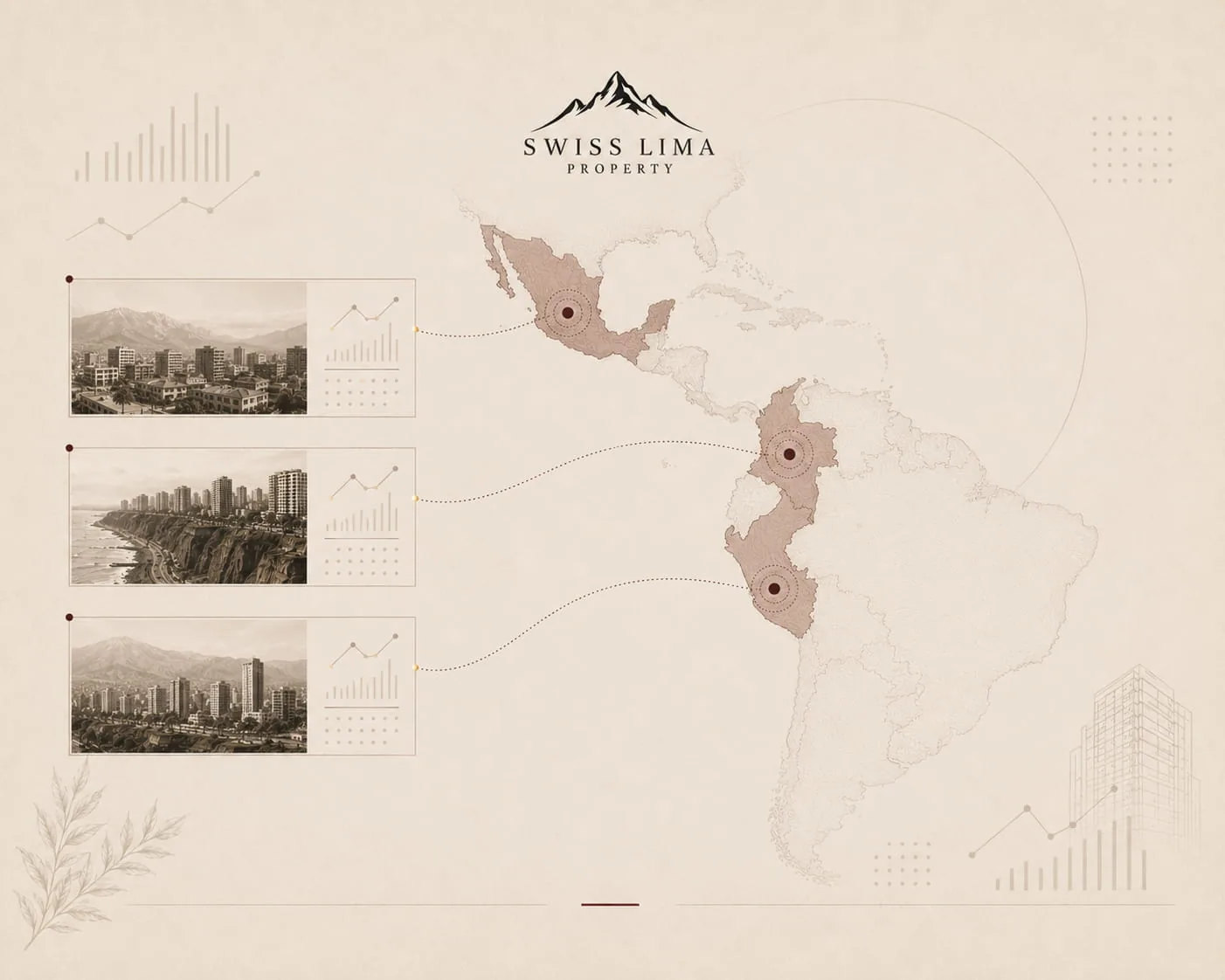
Foreigners' rights: who can buy what
Before any comparison of prices or yields, it is worth setting out the fundamental legal framework: under what conditions can a European national acquire real estate in each of these countries?
Peru
Article 71 of the Political Constitution of Peru guarantees foreigners the same property rights as Peruvian citizens, subject to the exception of the border strip (50 km from land borders). There is no special procedure, quota or sector restriction for a foreign buyer in Lima. It is one of the most open frameworks in Latin America.
Colombia
Colombia also offers a framework favourable to foreign investors. Foreign nationals can acquire real property in Colombia without particular restriction. Foreign real estate investment can be registered with the Colombian central bank (Banco de la República), which facilitates the repatriation of income and capital. Transactions are generally conducted in Colombian pesos (COP), with more pronounced exchange-rate exposure than for the Peruvian sol.
Mexico
In Mexico, the legal framework is more complex. The Mexican Constitution distinguishes two zones:
- Ordinary zone: foreigners can buy freely.
- Restricted zone (zona restringida): 100 km from land borders and 50 km from coastlines. Direct purchase by a foreigner is prohibited; the reference structure for residential ownership in these zones is the fideicomiso (a trust set up with a Mexican bank), which generates annual fees and an additional legal layer. Setting up a Mexican company is another possible route, but it is not an automatic solution; the tax and operational implications differ significantly depending on the structure chosen. The most popular tourist destinations for foreigners (Playa del Carmen, Tulum, Los Cabos) are all in the restricted zone.
Legal information on Colombia and Mexico must be verified with qualified local legal professionals, as regulations may change.
Peru (Lima)
Lima is the economic, cultural and administrative capital of a country of approximately 34 to 35 million inhabitants according to recent projections. Lima Metropolitana had approximately 10.13 million inhabitants in 2025, around 29.7% of the Peruvian population according to INEI, and approximately 45% of national GDP.
- Peru's GDP: approximately USD 289.22 billion; GDP/capita approximately USD 8,452 (World Bank 2024)
- Growth: slight contraction in 2023, rebound to approximately 3% in 2024 (IMF); 2026 forecast around 2.8% (IMF WEO), relatively solid trajectory in Latin America
- Currency: Peruvian sol (PEN), managed float by the BCRP, relative stability
- Property prices: BCRP basket of 12 districts in Lima ~USD 2,009/m² in Q4 2025; premium, new-build, very well-located or view properties: range USD 2,500–3,500/m² (GlobalPropertyGuide/BCRP)
- Indicative gross rental yields: around 5% to 6.5%, before taxation, vacancy, charges, management and maintenance, never guaranteed (GlobalPropertyGuide/Adondevivir)
- Foreigners' rights: equal to nationals (Art. 71 of the Constitution)
- Taxation of non-resident rental income: withholding of approximately 5% (PPHND regime) according to SUNAT when the tenant is domiciled in Peru; the arrangements differ if the tenant is not domiciled in Peru, to be verified with a Peruvian tax adviser
Advantages for a European investor: a clear constitutional framework, a relatively stable currency, a market denominated in USD in the premium segments, a growing pool of local professionals, a moderate cost of living for on-site management.
Points of vigilance: recurring political instability (frequent changes of government), a less liquid market than in Europe, seismic risk (Lima is in an active seismic zone).
Our specialty: Lima
Swiss Lima Property focuses exclusively on the Lima market. If your thinking is leaning towards Lima, our on-the-ground knowledge can save you valuable time.
Colombia (Bogotá, Medellín)
Colombia is one of the major economies of Latin America, behind Brazil and Mexico, and depending on the year in a rank close to or behind Argentina by GDP. Bogotá, its capital of more than 8 million inhabitants, is a major financial and cultural centre. Medellín has undergone a profound transformation over the past two decades and attracts a growing community of expats and digital nomads.
- Colombia's GDP: approximately USD 418.82 billion; GDP/capita approximately USD 7,919 (World Bank 2024)
- Growth: variable by year, approximately 1–2% in 2023, around 2% in 2024 (IMF)
- Currency: Colombian peso (COP), historically more volatile than the Peruvian sol
- Premium property prices (Bogotá, El Poblado in Medellín): approximately USD 1,500–2,500/m² depending on the area (indicative data, local sources)
- Gross rental yields: approximately 5–6% estimated (indicative data)
- Foreigners' rights: free access to property, registration possible with the Banco de la República
Advantages for a European investor: the dynamism of the Bogotá and Medellín markets, a strong international presence and expat community, a developed entrepreneurial culture.
Points of vigilance: the Colombian peso is markedly more volatile than the Peruvian sol; an investor assessing returns in EUR or CHF must factor in more significant currency risk. The security situation, although improved, remains a factor to assess depending on the area.
Mexico (Mexico City, Playa del Carmen)
Mexico is the second-largest economy in Latin America. Mexico City, with more than 21 million inhabitants in its metropolitan area, is a large-scale real estate market. The tourist destinations of the Yucatán peninsula (Playa del Carmen, Tulum, Cancún) attract strong seasonal rental demand.
- Mexico's GDP: approximately USD 1,856.37 billion; GDP/capita approximately USD 14,186 (World Bank 2024), the largest of the three countries compared
- Growth: approximately 3.2% in 2023, around 1.5% in 2024 (IMF)
- Currency: Mexican peso (MXN), relatively stable but subject to US economic cycles
- Premium property prices (Mexico City, Polanco): approximately USD 3,000–5,000/m² depending on the area (indicative data)
- Coastal destinations (Playa del Carmen): highly variable market, significant seasonal tourist rental demand
- Gross rental yields: approximately 4–5% in long-term residential rental (indicative data)
- Foreigners' rights: free in the ordinary zone; fideicomiso required in the restricted zone (coasts and borders)
Advantages for a European investor: the largest and most liquid market of the three countries, strong international tourism, a developed tourist rental market in coastal destinations.
Points of vigilance: the fideicomiso adds complexity and cost for coastal tourist destinations. Strong economic dependence on the United States exposes the market to US cycles. The security situation varies significantly by region and must be assessed case by case.
Summary comparison table
This table summarises the main comparison criteria. All data are indicative and must be verified.
| Criterion | Peru (Lima) | Colombia (Bogotá/Medellín) | Mexico (CDMX/coasts) |
|---|---|---|---|
| Foreigners' rights | Equal to nationals (Art. 71) | Free, optional registration | Free (fideicomiso in restricted zone) |
| Indicative premium prices | USD 2,500–3,500/m² | USD 1,500–2,500/m² | USD 3,000–5,000/m² (CDMX) |
| Indicative gross yields | 5–6.5% indicative (gross) | 5–6% | 4–5% |
| Currency stability | High (managed float, BCRP) | Moderate (COP volatile) | Moderate (linked to US) |
| Legal complexity | Low for foreigners | Low to moderate | Moderate to high (coasts) |
| Market size | Intermediate | Intermediate | Large |
| Political risk | Frequent government instability | Moderate, notable improvement | Variable by region |
Indicative data and sources only. GDP figures: World Bank 2024 (actuals). 2025–2026 growth figures are IMF (WEO) projections and should not be confused with actual data. Verify with local professionals in each country.
Macroeconomic stability and currency risk
For a European investor assessing their portfolio in EUR or CHF, currency risk is a major differentiating factor.
The Peruvian sol (PEN) moves according to supply and demand, under a floating exchange-rate regime. The Central Bank of Peru nonetheless intervenes occasionally to limit excessive fluctuations. Furthermore, Lima's real estate market is frequently denominated in US dollars, which reduces direct exposure to the PEN, but creates exchange-rate risk between the USD and the CHF or EUR.
The Colombian peso (COP) has historically shown greater volatility, notably correlated with oil prices (Colombia is an exporting country). An investor who has bought a property in Bogotá may see the return on their investment in CHF significantly affected by COP/CHF fluctuations.
The Mexican peso (MXN) is strongly correlated with the US economic cycle and Fed policy. Its relative stability compared to other emerging currencies is linked to economic proximity with the United States, an advantage during periods of US growth, a risk during periods of recession.
Practical accessibility for a European investor
Beyond the legal framework and financial data, practical conditions influence how easily a European investor can manage their investment remotely.
- Time difference with Europe: Lima (UTC-5), Bogotá (UTC-5), Mexico City (UTC-6). Similar distances from Europe, approximately 12–13 hours' flight from Paris or Geneva.
- Language: Spanish in all three countries. The availability of French- or English-speaking local professionals varies by city. Lima has an active French-speaking community and a historic Swiss presence.
- Banking infrastructure: all three countries have functional banking systems for international transfers. Colombia has a mechanism for registering foreign investments with the Banco de la República, useful for repatriation.
- Remote management: in all three countries, remote rental management is possible via local agencies. The quality and reliability of these agencies vary considerably; selecting the local manager is a critical step in all three cases. See our partner Havenbnb Peru.
Risks specific to each market
None of these three markets is free of specific risks that a European investor must take into account:
- Peru: recurring political instability (the country has had numerous presidents in a few years), significant seismic risk in Lima, a less liquid market than Western markets.
- Colombia: volatility of the Colombian peso, a security situation that varies by neighbourhood and city, a recent tax reform that has increased taxation on high incomes (indirect impact on the prestige real estate market).
- Mexico: legal complexity of the fideicomiso in tourist zones, strong competition in the tourist rental market, economic dependence on the United States, a security situation that varies by region.