
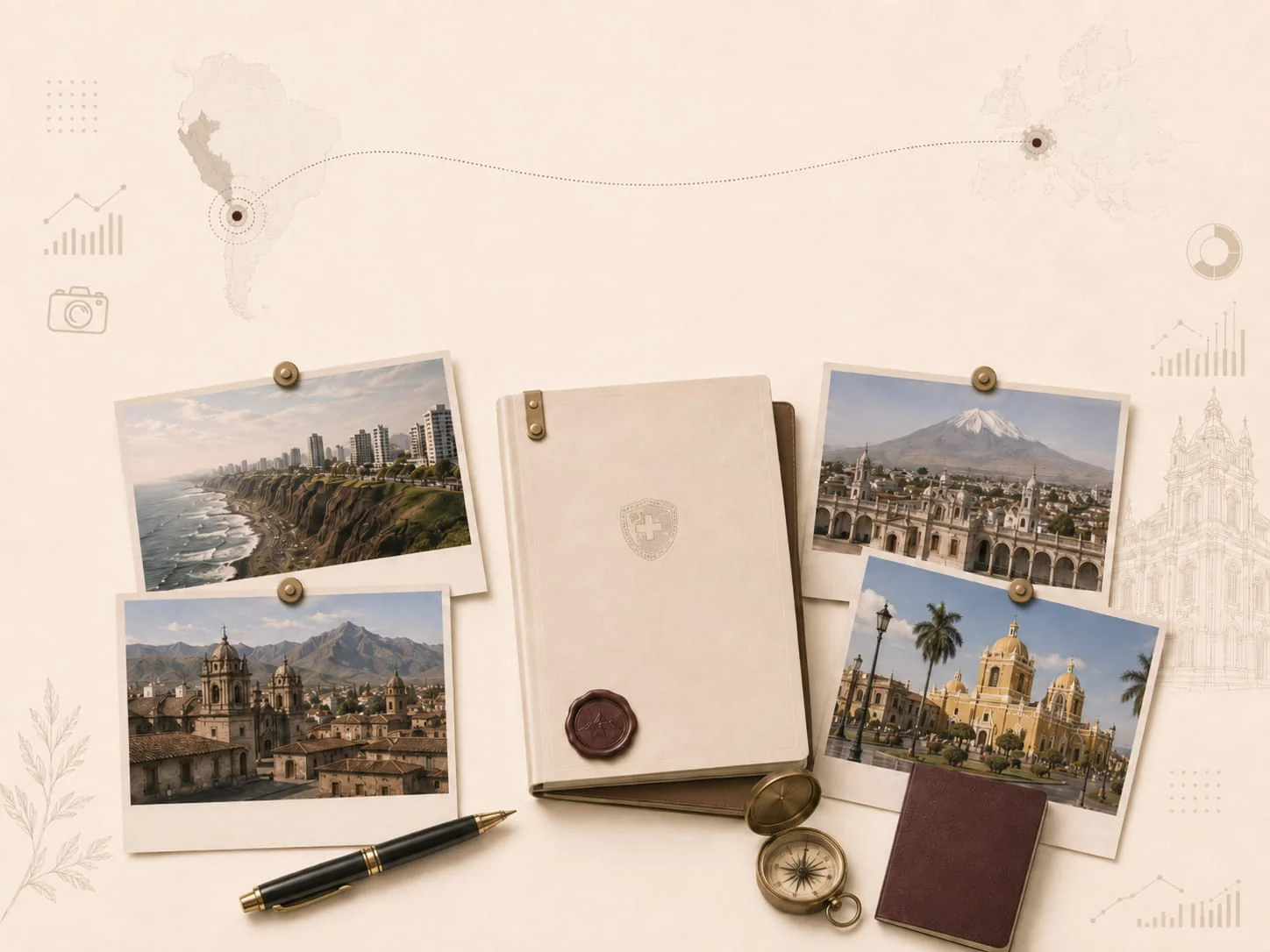
How to choose which cities to visit in Peru
Peru is a vast country, divided between a desert coast, an Andean cordillera and an immense Amazon basin. This geography has a direct consequence: not all Peruvian cities serve the same purpose within an itinerary, and trying to add them all together rarely makes for a good trip.
Some are cultural destinations in their own right, for their historic centre, their architecture or their atmosphere: Cusco, Arequipa, Ayacucho or Trujillo. Others, such as Chiclayo, Puno, Huaraz or Piura, are valuable above all for what they give access to: a major museum, a lake, a mountain range, a coastline. This is not a hierarchy of quality, but a difference in nature worth knowing before booking three nights somewhere.
Altitude is the second filter. Cusco sits at around 3,400 metres, Puno close to 3,800, Huaraz roughly 3,050, Cajamarca and Ayacucho around 2,700. These figures change the pace of the first few days, the quality of your sleep and your ability to walk for long periods. Arriving from Lima, at sea level, into a city at 3,800 metres requires an acclimatisation that many itineraries underestimate.
Season then acts differently from region to region: summer sun and winter garúa on the coast, a dry season favourable to hiking in the Andes, and an alternation of high and low water in the Amazon. Our guide on when to visit Peru sets out these calendars region by region.
Then there are the distances. Lima and Cusco are separated by a little over an hour by air, but more than twenty hours by bus. Domestic flights, numerous from Lima which acts as the national hub, save considerable time on long journeys. Buses remain relevant on a regional scale, between Trujillo and Chiclayo or between Cusco and Puno.
The mistake to avoid
Do not choose cities simply because they are well known. A city can be magnificent and still fit badly into your itinerary if it imposes too much travel, too much altitude or a detour that makes little sense given the time available.
The most effective approach is to think in terms of regions rather than isolated cities. An itinerary built around two or three coherent geographical hubs leaves time to walk, observe and understand. An itinerary that stacks eight cities into fifteen days turns into a succession of airports and bus terminals. To situate the country's major stops, our guide on what to see in Peru and the one devoted to Peru's three great regions offer complementary readings, one by site, the other by territory.
Lima, cultural and gastronomic capital
Lima is too often treated as a waiting room: one night on arrival, one night on the way back, and the substance of the trip elsewhere. That is a reductive reading of a city of nearly ten million inhabitants, the country's political, economic and cultural capital, set on cliffs facing the Pacific.
The historic centre, inscribed on the UNESCO World Heritage List, preserves one of the most important colonial ensembles in South America: the Plaza Mayor, the cathedral, the San Francisco monastery and its catacombs, and the carved wooden balconies of the viceregal period. A few kilometres away, Miraflores lines its buildings above the ocean, with the Malecón and its parks suspended over the Costa Verde. Barranco cultivates an atmosphere of workshops, galleries and colourful republican houses. San Isidro concentrates the business district, while Pueblo Libre is home to two of the country's most important museums.
Lima is also a city of museums, and that is the strongest argument for spending time here at the beginning of a trip rather than at the end. The Museo Larco, the MALI, Huaca Pucllana and the Museo Amano provide interpretive keys that serve everywhere else afterwards, at Chan Chan as much as in the Sacred Valley. Our guide on the essential museums in Lima details that selection, and Peruvian gastronomy is the subject of a guide of its own.
Why go?
Lima allows you to understand contemporary Peru: food, museums, the coastline, residential districts and the country's economic energy. It is the city where Peru's different regions genuinely meet, through internal migration, regional cuisines and markets.
Which type of traveller is it for?
- A first trip to Peru, to establish context before the Andes.
- Food lovers and those drawn to urban culture.
- Expatriates, future residents and long-term travellers.
- Investors and those on a scouting trip.
- Travellers who want to understand the city before touring the rest of the country.
What to see nearby
- Historic centre, Plaza Mayor and the San Francisco monastery.
- Museo Larco and Museo Nacional, in Pueblo Libre.
- Huaca Pucllana, a pre-Hispanic site in the heart of Miraflores.
- The Miraflores Malecón and the Costa Verde.
- Barranco: galleries, republican architecture and the Puente de los Suspiros.
Would you like to understand Lima's districts better?
Swiss Lima Property presents the capital's main residential districts, their atmospheres, their advantages and their lifestyle profiles.
Practical information, to be checked at the time of travel:
- Region: Lima
- Suggested duration: 2 to 4 days, more for a scouting trip or an extended stay
- Ideal for: museums, gastronomy, coastline, urban life, understanding contemporary Peru
- Points to consider: significant travel times between districts, ordinary urban vigilance depending on the area and time of day
Cusco, the former Inca capital
Cusco holds a particular place in the history of the continent. Capital of the Inca Empire, the Tahuantinsuyo, it was its political, religious and symbolic centre, the point from which the empire's four great roads set out. The city has been inscribed on the UNESCO World Heritage List since 1983.
What strikes you in Cusco is the layering. The Spanish did not raze the Inca city: they built on top of it. Perfectly fitted stone walls, laid without mortar, still serve today as foundations for churches and colonial houses. The Qorikancha, the former Temple of the Sun, literally supports the Santo Domingo convent, and the Plaza de Armas occupies the site of the former ceremonial square.
The San Blas district, with its steep lanes and artisans' workshops, offers another face of the city; the markets, including San Pedro, show everyday Cusco. On the immediate outskirts, Sacsayhuamán recalls the scale of Inca engineering. Cusco naturally serves as the starting point for the Sacred Valley, Ollantaytambo, Pisac and Machu Picchu, but reducing the city to that function means missing the essential: it is a living city, at once Andean and colonial, where contemporary Quechua culture occupies a real place.
Cusco is not only a stop on the way to Machu Picchu
The city deserves time to understand Inca history, Spanish colonisation, religious art, altitude and present-day Andean culture.
Practical information, to be checked at the time of travel:
- Region: Cusco
- Altitude: around 3,400 metres, to be confirmed depending on the source consulted
- Suggested duration: a minimum of 2 to 4 days depending on the itinerary, not counting the Sacred Valley
- Ideal for: Inca history, architecture, colonial art, Andean culture, access to Machu Picchu
- Points to consider: altitude to respect from arrival, heavy visitor numbers in high season
Arequipa, the white city
Arequipa owes its nickname of the white city to sillar, the pale volcanic stone quarried nearby, with which much of the historic centre was built. The result is immediately recognisable: luminous façades, thick vaults and baroque carving worked into a material that responds to the light of southern Peru. The historic centre has been inscribed on the UNESCO World Heritage List since 2000.
The Plaza de Armas, bordered by arcades on three sides and dominated by the cathedral, is among the most elegant in the country. A few streets away, the Santa Catalina monastery forms a genuine city within the city: a conventual complex covering several hectares, with its own streets, squares and walls painted in ochre and blue, long closed to the outside world.
Above the city, the Misti volcano imposes its conical silhouette, accompanied by Chachani and Pichu Pichu. At under 2,340 metres, Arequipa sits considerably lower than Cusco, which makes acclimatisation gentler for many travellers.
The city has a strong regional identity and a culinary tradition of its own. The picanterías, popular establishments serving rocoto relleno, adobo or chupe de camarones, are its most concrete expression. Arequipa is also the classic departure point for the Colca Canyon, a few hours away by road.
Why Arequipa appeals so much
Arequipa combines architecture, food, a pleasant climate, regional identity and proximity to great Andean landscapes. It is often one of the cities most appreciated by travellers who want to slow the pace.
Practical information, to be checked at the time of travel:
- Region: Arequipa
- Altitude: around 2,335 metres
- Suggested duration: 2 to 3 days, more with the Colca Canyon
- Ideal for: architecture, gastronomy, the southern Andes, a calmer pace
- Points to consider: moderate but real altitude, Colca excursions to be planned separately
Trujillo, colonial elegance and Moche heritage
Trujillo, on the northern coast, is probably the large Peruvian city most underestimated by European travellers. Its historic centre preserves a set of colonial and republican houses with façades painted in bold colours, blue, yellow and ochre, arranged around a particularly generous Plaza de Armas.
Trujillo's interest extends well beyond its architecture. The city lies at the heart of a region that was the cradle of two great pre-Hispanic civilisations, long predating the Incas. A few kilometres away, Chan Chan, capital of the Chimú kingdom, is one of the largest earthen-architecture cities in the Americas. The site has been inscribed on the UNESCO World Heritage List since 1986 and appears simultaneously on the List of World Heritage in Danger, owing to the fragility of adobe in the face of erosion and extreme climatic events.
Further south, the Huacas del Sol y de la Luna bear witness to the Moche culture, whose polychrome friezes are among the most remarkable on the continent. On the nearby coast, Huanchaco preserves its caballitos de totora, reed craft used by fishermen for centuries and now shared with surfers. Together they form a region where archaeology, the sea and urban life answer one another.
Why include Trujillo in an itinerary?
Trujillo allows you to discover a Peru less centred on the Incas. The north of the country reveals ancient civilisations, coastal towns, different traditions and another rhythm of travel.
Practical information, to be checked at the time of travel:
- Region: La Libertad
- Suggested duration: 2 to 3 days
- Ideal for: archaeology, northern Peru, colonial centre, Huanchaco
- Points to consider: scattered archaeological sites, transport to organise, urban vigilance depending on the district
Chiclayo, gateway to the northern civilisations
Chiclayo calls for an honest approach. This is not a city you visit for its historic centre, which is more functional than monumental. Its interest lies elsewhere, and it is considerable: Chiclayo is the most practical logistical base for discovering the most spectacular archaeology northern Peru has produced.
In Lambayeque, the Museo Tumbas Reales de Sipán displays the contents of the tomb of the Lord of Sipán, discovered in 1987 and considered one of the richest intact burials ever uncovered in the Americas. Its design, which recreates the descent towards the burial chamber, makes it a museum apart in the Peruvian landscape. Not far away, Túcume and its earthen pyramids complete the circuit.
The city also has a well-regarded regional cuisine, with preparations specific to the north such as arroz con pato, as well as a market, the Mercado Modelo, where the commercial vitality of the region is plain to see.
Not to be judged too quickly
Some Peruvian cities are interesting above all for what they allow you to understand around them: museums, archaeological sites, markets, food or neighbouring territories.
Practical information, to be checked at the time of travel:
- Region: Lambayeque
- Suggested duration: 1 to 2 days
- Ideal for: Moche history, museums, northern cuisine, archaeology
- Points to consider: mainly logistical and cultural interest, coastal heat depending on the season
Cajamarca, Andean history and provincial calm
Cajamarca, in the northern Andes, is the city where one of the most decisive episodes in the continent's history played out: the meeting and then the capture of the Inca Atahualpa by Spanish forces in 1532. The Cuarto del Rescate, the so-called ransom room, still stands in the centre of the city and is one of the few Inca buildings still visible in Cajamarca.
The city has preserved a coherent historic centre, arranged around a Plaza de Armas framed by the cathedral and the San Francisco church, with a set of baroque buildings carved from local volcanic stone. Cerro Santa Apolonia offers a viewpoint over the city and the valley.
On the outskirts of Cajamarca, the Baños del Inca, thermal springs used since pre-Hispanic times, extend the visit in a more relaxed register. The surrounding countryside, green and rolling, produces cheeses renowned throughout the country, giving the region an appearance that is unusual for anyone who associates the Andes with aridity.
A city for taking your time
Cajamarca reveals itself less in haste than in the logic of a more settled stay: heritage, history, markets, Andean countryside and local atmosphere.
Practical information, to be checked at the time of travel:
- Region: Cajamarca
- Altitude: around 2,700 metres
- Suggested duration: 2 days or more
- Ideal for: history, the northern Andes, a calm pace, local culture
- Points to consider: longer access from Lima, rainy season to bear in mind for excursions
Ayacucho, crafts, churches and living culture
Ayacucho, in the central Andes, is a city where culture is not a layer added for visitors but a daily practice. Its historic centre contains a remarkable number of colonial churches, often counted in dozens, whose stone façades and interior altarpieces testify to the religious importance the city once held.
Crafts occupy a central place here. The Santa Ana district brings together workshops for weaving, Huamanga stone carving and above all retablos, those painted boxes that open onto miniature scenes and form one of the most identifiable artistic traditions in Peru. These objects belong to a documented tradition, passed down between generations of artisans. Holy Week in Ayacucho is also among the most important religious celebrations in the country, with processions that mobilise the entire city for several days.
The region was deeply affected by the period of violence Peru experienced between 1980 and 2000. That past is part of the history of the place, addressed locally through sites of memory and long-term social work; approaching it with respect, without turning it into a tourist argument, is part of a well-conducted visit. Nearby, the Wari site and the Quinua complex recall that the region was a centre of power long before the Incas.
A cultural city, not only a tourist one
Ayacucho is particularly interesting for understanding the place of crafts, religion, festivals, memory and popular culture in the Peruvian Andes.
Practical information, to be checked at the time of travel:
- Region: Ayacucho
- Altitude: around 2,750 metres
- Suggested duration: 2 to 3 days
- Ideal for: culture, crafts, festivals, history, the Andes
- Points to consider: access mainly by air from Lima, accommodation in very high demand during Holy Week
Puno, altiplano city and gateway to Lake Titicaca
Puno presents itself without pretence: the city, set on the shore of Lake Titicaca at nearly 3,800 metres, does not have the architectural elegance of Cusco or Arequipa. Its centre is modest, its urban fabric irregular, and many travellers stay only one night. That observation does not diminish its interest, it shifts it.
Puno is the gateway to Lake Titicaca, the highest major navigable lake in the world, shared with Bolivia. Boats leave its port for the Uros islands, floating constructions of totora reed, as well as for Taquile and Amantaní, where communal organisation, textiles and homestays define an experience very different from the rest of the country.
The city is also considered the capital of Peruvian folklore. The Virgen de la Candelaria festival, in February, mobilises thousands of dancers and musicians. This festive dimension and the Aymara and Quechua heritage of the altiplano give Puno an identity unrelated to that of the coastal cities.
The lake before the city?
Many travellers come to Puno for Lake Titicaca more than for the city itself. That is precisely what makes it interesting: it serves as the gateway to a very particular cultural and natural territory.
Practical information, to be checked at the time of travel:
- Region: Puno
- Altitude: around 3,800 metres, one of the highest in this guide
- Suggested duration: 1 to 2 days depending on lake excursions
- Ideal for: Lake Titicaca, the altiplano, Andean culture, itineraries towards Bolivia
- Points to consider: high altitude, cold nights all year round, better reached already acclimatised from Cusco than directly from Lima
Huaraz, Peru's mountain capital
Huaraz assumes a clear function: it is the base for Peru's high mountains. The city itself, largely rebuilt after the 1970 earthquake that devastated the region, offers no monumental ensemble. You come here for what surrounds it, and what surrounds it is exceptional.
Huaraz opens onto the Cordillera Blanca, the highest tropical mountain range in the world, protected by Huascarán National Park, inscribed on the UNESCO World Heritage List in 1985 and managed by SERNANP. Huascarán itself rises to 6,768 metres, the highest point in Peru. The park is home to several hundred glaciers, close to three hundred high-altitude lakes, the Andean condor and the spectacled bear.
Classic excursions include Laguna 69, the turquoise Llanganuco lakes and the Pastoruri sector, access to which varies according to conditions and park management decisions. Multi-day treks, such as Santa Cruz, are aimed at prepared walkers. Further south, the site of Chavín de Huántar, also inscribed on the World Heritage List, documents one of the oldest Andean cultures.
For Swiss travellers
Huaraz will speak to mountain lovers, but the experience differs from the Alps: harsher altitude, long distances, simpler infrastructure and very specific Andean landscapes.
Practical information, to be checked at the time of travel:
- Region: Áncash
- Altitude: around 3,050 metres for the city, considerably higher for excursions
- Suggested duration: a minimum of 3 to 5 days to make the most of the surroundings
- Ideal for: hiking, mountains, nature, photography, active travellers
- Points to consider: acclimatisation essential before any high-altitude hike, dry season clearly more favourable, park conditions to be checked with SERNANP
Iquitos, the great Amazonian city
Iquitos is a fascinating geographical anomaly: it is one of the largest cities in the world that cannot be reached by road. You arrive by plane or by river, and no other way. That isolation has shaped its character, its economy and its rhythm.
The city owes its development to the rubber boom of the late nineteenth and early twentieth centuries, a period during which considerable fortunes were built on the exploitation of latex and on the forced labour of indigenous populations. That painful history left an unexpected architectural legacy in the middle of the Amazon: houses adorned with azulejos imported from Portugal and European-style buildings, including the Casa de Fierro attributed to Gustave Eiffel's workshop.
The Belén district, with its market and its houses on stilts or floating according to the level of the river, gives a concrete picture of urban Amazonian life, where mototaxis replace cars everywhere. Iquitos finally serves as the departure point for the lodges of the selva, the Pacaya-Samiria national reserve and river cruises. The city is not the forest, but it is its threshold.
A city isolated by geography
Iquitos is a reminder that the Amazon is not only a forest to visit. It is also an urban, commercial, cultural and historical space with rhythms of its own.
Practical information, to be checked at the time of travel:
- Region: Loreto
- Suggested duration: 2 days in the city, more with a lodge or a cruise
- Ideal for: the Amazon, the river, urban Amazonian culture, nature
- Points to consider: access only by plane or boat, high heat and humidity, operators to be chosen with care
Tarapoto, nature and accessible Amazon
Tarapoto, in the San Martín region, offers another reading of the Peruvian Amazon. Located in the selva alta, the foothill forest, the city enjoys a warm climate without the extreme humidity of the lowlands and, above all, far better accessibility: it is connected by road and by daily flights from Lima.
The surroundings concentrate waterfalls, lagoons and rivers: the Ahuashiyacu falls, Laguna Azul, the Lamas area with its forest Quechua community, and Moyobamba, known for its orchids, form a set of short excursions from the city.
The region produces coffee and cocoa, developed by local supply chains that can be visited in certain areas. Amazonian cuisine is well represented, with juane, tacacho con cecina and river fish. The atmosphere is more relaxed and less spectacular than in Iquitos, which suits a certain kind of trip.
A more accessible Amazon
Tarapoto often suits travellers who want a more flexible Amazonian experience, with a city, nature, excursions and varied accommodation, without necessarily embarking on a long expedition.
Practical information, to be checked at the time of travel:
- Region: San Martín
- Suggested duration: 3 days or more
- Ideal for: nature, waterfalls, Amazonian cuisine, a more relaxed stay
- Points to consider: constant heat, rain possible all year round, winding mountain roads towards Moyobamba
Chachapoyas, mountains, Kuélap and Amazonas
Chachapoyas, capital of the Amazonas region, occupies a remarkable geographical in-between: neither entirely Andean nor entirely Amazonian, in a world of cloud forest, deep valleys and green relief. The town, small and colonial, serves as a base for a territory that is among the most interesting in the country.
Kuélap is its major site: a fortified city of the Chachapoyas culture, perched at over 3,000 metres and surrounded by a wall that reaches nearly twenty metres in places. The site underwent substantial conservation work after part of its southern wall collapsed in 2022, and its visitor circuits have changed since. The cable car remains the principal means of access. Exact conditions should be checked with the Ministry of Culture before planning a visit.
The Gocta waterfall, one of the highest in Peru, is reached on foot from neighbouring villages. The sarcophagi of Karajía, set on a cliff face, and the mausoleums of Revash testify to funerary practices particular to this culture. The area remains far less frequented than the south of the country.
For a second trip to Peru
Chachapoyas is ideal for those who already know Lima, Cusco or Arequipa and want to discover a more confidential Peru, between mountains, cloud forest and northern archaeology.
Practical information, to be checked at the time of travel:
- Region: Amazonas
- Suggested duration: a minimum of 3 to 4 days
- Ideal for: nature, archaeology, slower travel, a less conventional Peru
- Points to consider: long access from Lima, mountain roads, Kuélap visiting conditions to confirm before departure
Oxapampa and Pozuzo, another side of Peru
In the Pasco region, in the selva alta, Oxapampa and Pozuzo tell a story few travellers associate with Peru. In the mid-nineteenth century, under the presidency of Ramón Castilla, the Peruvian state encouraged the settlement of its Amazonian territories by European families. A first group of Tyrolean and Rhenish colonists left Antwerp in 1857 and, after an extremely difficult crossing and overland march, founded Pozuzo in 1859. Oxapampa was founded later by descendants of those same families.
The result is a built environment that stands out: wooden houses with steep roofs, churches of Tyrolean inspiration, culinary traditions and festivals that blend Austro-German heritage with Peruvian and Amazonian cultures. Around them, the landscape is one of humid mountain forest, with coffee plantations and the nearby Yanachaga-Chemillén National Park; the Oxapampa district forms part of a biosphere reserve recognised by UNESCO, which combines conservation with the presence of local communities, including the Yánesha people.
These places are not priority stops on a short first trip: they require road time and fit poorly into a classic Lima, Cusco, Arequipa circuit. They come into their own, however, on a longer stay or a second trip.
Practical information, to be checked at the time of travel:
- Region: Pasco
- Suggested duration: 2 to 4 days
- Ideal for: nature, unusual culture, slow travel, a less conventional route
- Points to consider: access only by road from Lima, long and winding journeys, more limited accommodation
Piura and the northern coast
Piura, on the far northern coast, belongs to a different Peru: hotter, drier, turned towards agriculture, trade and the sea. The city is old, founded in the sixteenth century, but today it is of interest more for its regional function than for its monumental heritage.
It is from Piura that you reach the northern coastline and its beaches: Máncora, the best known, but also Vichayito, Los Órganos, Colán or, further north still, the Tumbes region. This coast enjoys marked sunshine for much of the year and warmer water than in the centre and south of the country, which explains its popularity with Peruvians themselves.
Northern cuisine is the region's other argument, with its ceviches, its seco de chavelo and its local production of limes. Catacaos, nearby, remains a crafts centre known for silver filigree and pottery. Piura is therefore less a museum city than a gateway to the northern coast, its food and its climate.
Practical information, to be checked at the time of travel:
- Region: Piura
- Suggested duration: depending on the itinerary, often short in the city itself
- Ideal for: the northern coast, beaches, food, warmth
- Points to consider: considerable heat, possible El Niño events in certain years, an additional journey to reach the beaches
Tacna, southern city and border gateway
Tacna, in the far south of the country, lies a few dozen kilometres from the Chilean border. It is above all a city of trade and movement, where exchanges with Arica, on the Chilean side, shape part of the local economy.
Its history gives it a particular place in the national imagination. Occupied by Chile following the War of the Pacific, the city was only reintegrated into Peru in 1929, after lengthy negotiations. That past explains the density of republican monuments in the centre, including the Arco Parabólico, as well as a pronounced patriotic identity.
The region, arid, includes irrigated valleys producing olives and wine, as well as thermal springs. Tacna is not among the classic stops on a first trip, but it may interest travellers exploring the south, coming up from Chile or drawn to border dynamics.
Practical information, to be checked at the time of travel:
- Region: Tacna
- Suggested duration: 1 day or according to the itinerary
- Ideal for: southern Peru, crossing into Chile, republican history, in-depth travel
- Points to consider: mainly logistical interest for most itineraries, border formalities to anticipate
Which cities to choose for your trip?
The groupings below are not rankings, but starting points for building a coherent itinerary according to what you are looking for.
Classic first trip
- Lima
- Cusco
- Arequipa if time allows
- Puno or Huaraz depending on interest
Cultural trip
- Lima
- Cusco
- Arequipa
- Trujillo and Chiclayo
- Ayacucho
Food-focused trip
- Lima
- Arequipa
- Trujillo and Chiclayo
- Piura
- Tarapoto
Nature and mountain trip
- Huaraz
- Cusco
- Chachapoyas
- Arequipa
- Puno
Amazon trip
- Iquitos
- Tarapoto
- Chachapoyas for the transition between mountains and cloud forest
Long stay or second trip
- Cajamarca and Ayacucho
- Chachapoyas
- Oxapampa and Tarapoto
- Trujillo and Chiclayo
A life project or a scouting trip
For a relocation project or an extended stay, the logic differs from that of a holiday. Lima concentrates most of the infrastructure, services, international air links and the formal property market. Arequipa and Cusco may suit certain profiles, depending on personal and professional objectives. The regional cities presented in this guide are fascinating to discover, but not all of them are suited to settling long term as a European: that is a question to address separately, with the right information.
Summary table of the cities
This table summarises, for guidance only, the cities presented in this guide. It is not a ranking: each city has its own value depending on the traveller's profile, the season and the time available. The "point to watch" column flags what deserves attention when planning, without any value judgement on the city itself.
| City | Region | Main atmosphere | Ideal for | Suggested duration | Point to watch |
|---|---|---|---|---|---|
| Lima | Lima | Oceanic, urban capital | Museums, food, long stays | 2 to 4 days | Travel times between districts, vigilance by area |
| Cusco | Cusco | Andean and colonial | Inca history, Sacred Valley | 2 to 4 days | Altitude, heavy visitor numbers in high season |
| Arequipa | Arequipa | Elegant and volcanic | Architecture, food, Colca | 2 to 3 days | Moderate altitude, Colca to plan separately |
| Trujillo | La Libertad | Colonial and coastal | Moche and Chimú archaeology | 2 to 3 days | Scattered sites, transport to organise |
| Chiclayo | Lambayeque | Commercial and regional | Northern museums, food | 1 to 2 days | Mainly logistical and cultural interest |
| Cajamarca | Cajamarca | Andean and provincial | History, countryside, slow pace | 2 days or more | Altitude, long access, rainy season |
| Ayacucho | Ayacucho | Cultural and artisanal | Crafts, churches, festivals | 2 to 3 days | Altitude, mainly air access, Holy Week in high demand |
| Puno | Puno | Altiplano and folklore | Lake Titicaca, Andean culture | 1 to 2 days | High altitude, cold nights, city secondary to the lake |
| Huaraz | Áncash | Mountains and hiking | Cordillera Blanca, treks | 3 to 5 days | Acclimatisation essential, season decisive |
| Iquitos | Loreto | Amazonian and riverine | River, lodges, urban culture | 2 days and more | Access only by plane or boat, heat and humidity |
| Tarapoto | San Martín | Relaxed foothill forest | Waterfalls, nature, food | 3 days or more | Heat, rain possible all year round |
| Chachapoyas | Amazonas | Mountains and cloud forest | Kuélap, Gocta, slow travel | 3 to 4 days | Long access, Kuélap visiting conditions to confirm |
| Oxapampa | Pasco | Selva alta and European heritage | Nature, unusual culture | 2 to 4 days | Long road access, poorly suited to a short first trip |
| Pozuzo | Pasco | Austro-German village in the forest | Migration history, slow stays | 1 to 2 days | Winding road from Oxapampa, limited options |
| Piura | Piura | Warm northern coast | Beaches, northern cuisine | Short in the city | Heat, additional journey to the beaches |
| Tacna | Tacna | Border and republican | The south, crossing into Chile | 1 day | Mainly logistical interest, border formalities |
Practical advice before you go
Do not try to see everything
Peru requires choices. Multiplying cities turns a trip into a succession of journeys and leaves little room for what makes a stay memorable: the time spent on the ground.
Group cities by region
A few coherent combinations: Lima and the central coast; Arequipa and the Colca Canyon; Cusco and the Sacred Valley; Trujillo and Chiclayo; Huaraz and the Cordillera Blanca; Iquitos or Tarapoto for the Amazon. Each forms a geographical whole that holds together.
Take altitude into account
Cusco, Puno, Huaraz, Cajamarca and Ayacucho call for an adapted pace, especially in the first twenty-four hours. Combining Lima and Puno on the same day is possible on paper, rarely comfortable in reality.
Check the season
The same city is not approached in the same way in the dry season and in the rainy season. Our guide on when to visit Peru details the periods by region.
Allow for travel times
Distances may look modest on a map but demand a great deal of time: relief, mountain roads, checkpoints and stops lengthen journeys considerably compared with what the mileage suggests.
Understand Lima's role
Lima is the country's air hub: most domestic connections pass through it. That is an itinerary constraint, but also an opportunity to discover a real city rather than cross an airport.
Adapt safety to the district
Generalising across an entire city is not helpful. Districts, times of day and modes of transport all change the experience. Asking locally, favouring reliable transport in the evening and being discreet with personal belongings correspond to ordinary urban vigilance, applicable in many large cities.
Keep time for walking
The most beautiful cities reveal themselves through their squares, markets, cafés, museums, viewpoints and side streets, far more than through a list of boxes to tick.
Key points
- Peru is not limited to Lima, Cusco and Machu Picchu.
- Lima is the best gateway for understanding contemporary Peru.
- Cusco and Arequipa are two major historic cities, but very different ones.
- Trujillo and Chiclayo open up the pre-Hispanic north.
- Cajamarca and Ayacucho offer a calmer, more cultural approach to the Andes.
- Puno is valuable above all as the gateway to Lake Titicaca.
- Huaraz is the reference for mountain lovers.
- Iquitos and Tarapoto give access to two different Amazonian experiences.
- Chachapoyas, Oxapampa and Pozuzo suit a more in-depth trip.
- A good itinerary in Peru is built by region, not by accumulating cities.
Frequently asked questions
Planning a trip?
SwissLima, our Peru travel guide, presents the regions of Peru one by one, so you can choose where to go by trip length and season. Read more: Where to go in Peru? The regions to discover.
What are the most beautiful cities in Peru?
Cusco, Arequipa, Lima, Trujillo, Ayacucho and Cajamarca are among the most remarkable in architectural and cultural terms. As beauty remains subjective, other cities such as Huaraz, Puno or Iquitos are valuable above all for their geographical setting and what they allow you to discover nearby.
Which city should you visit first in Peru?
Lima, in the great majority of cases. It is the country's main point of entry by air, and its museums provide interpretive keys useful for the rest of the trip. Starting at sea level also makes acclimatisation easier before heading up into the Andes.
Is Lima really worth it?
Yes, provided you give it more than one transit night. The UNESCO-listed historic centre, the museums of Pueblo Libre, the districts of Miraflores and Barranco, the coastline and the food scene amply justify two to three days on a first trip.
Is Cusco the most beautiful city in Peru?
Cusco is probably the most impressive in historical terms, through the unique layering of Inca and colonial architecture. Many travellers nonetheless prefer Arequipa for its atmosphere, its climate and its pace. Both deserve to be seen; they do not tell the same story.
Is Arequipa worth the detour?
Yes for most southern itineraries. Its sillar historic centre is a World Heritage site, its more moderate altitude eases acclimatisation, its regional cooking is well regarded and the Colca Canyon lies a few hours away by road.
Which cities should you visit in northern Peru?
Trujillo and Chiclayo form the most coherent pairing for pre-Hispanic archaeology, with Chan Chan, the Moche huacas and the Sipán museum. Cajamarca adds an Andean dimension, Chachapoyas a mountain and cloud-forest one, and Piura access to the northern coast.
Which city should you choose to discover the Peruvian Amazon?
Iquitos for a deep river experience, reachable only by plane or boat, with access to lodges and cruises. Tarapoto for a foothill Amazon that is easier to reach, more flexible and often less demanding logistically.
Which city should you choose for the mountains in Peru?
Huaraz, without hesitation, for the Cordillera Blanca and Huascarán National Park. Cusco also offers fine hiking, and Chachapoyas proposes a different register, between green relief and cloud forest.
Which cities are the most interesting for culture?
Cusco for Inca and colonial history, Lima for museums, Arequipa for architecture, Ayacucho for crafts and religious festivals, Trujillo and Chiclayo for the pre-Hispanic civilisations of the north.
How many cities can you visit in two weeks in Peru?
Three to four cities is a reasonable pace, allowing for domestic flights and altitude acclimatisation. Beyond that, the trip turns into a chain of journeys. One balanced example: Lima, Cusco and the Sacred Valley, then Arequipa or Puno.
Which cities should you skip if you have little time?
These are not cities to avoid, but to postpone: Chachapoyas, Oxapampa, Pozuzo, Tacna and Cajamarca require significant travel time and fit poorly into a short first trip. They come into their own on a longer journey.
Which Peruvian city is the most pleasant for a long stay?
Lima for its infrastructure, services, cultural life and international connections. Arequipa appeals to those looking for a city on a more human scale with a pleasant climate. Cusco suits certain profiles, but altitude is a factor not to be underestimated over time.
Which city should you choose for a second trip to Peru?
Chachapoyas, Cajamarca, Ayacucho, Tarapoto or Oxapampa. These destinations are less frequented, require more time and are aimed at travellers who already know the main stops in the south.
Do you need to hire a car to visit Peru's cities?
It is generally neither necessary nor recommended for a first trip. Domestic flights cover long distances, intercity buses serve the main routes well, and local excursions are easily arranged on the spot. Hiring may be justified for exploring a specific area, such as the Sacred Valley or the surroundings of Tarapoto, bearing in mind local driving conditions.