
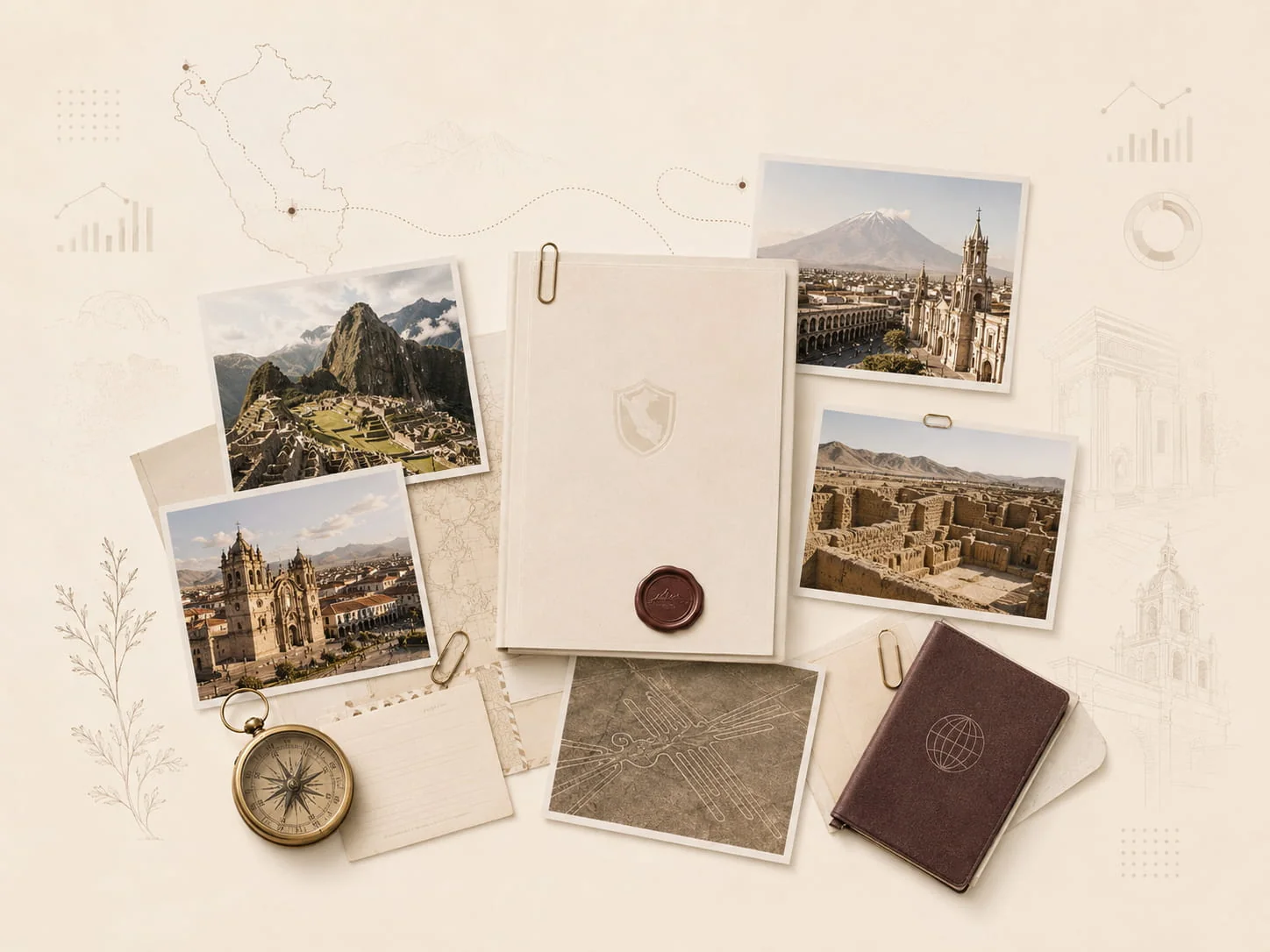
Understanding World Heritage in Peru
Inscription on the World Heritage List is not a tourism label. It recognises outstanding universal value, meaning an importance that extends beyond the borders of a single country, and it comes with obligations: the State undertakes to conserve the property, monitor its condition and report on its management.
Peru ratified the World Heritage Convention in February 1982. Its properties span periods far removed from one another: coastal urban societies predating the Incas by several millennia, pre-Inca Andean sanctuaries, the Inca peak, the Spanish colonial city, and natural areas ranging from high mountains to Amazonia.
This diversity has a practical consequence. An inscribed property is not necessarily a site laid out for visitors. Some, like Cusco or the historic centre of Lima, are living districts you walk through freely. Others are protected areas where access is regulated, or closed to ordinary tourism, precisely because their fragility justifies protection. Heritage value and ease of visiting are two separate things.
The mistake to avoid
Do not confuse a "well-known site" with an "inscribed site". Not every famous place in Peru is on the World Heritage List, and some UNESCO properties remain little known to the general public.
Inscription must also be distinguished from other schemes often confused with it: the tentative list, which records properties a country may one day propose without their being inscribed, biosphere reserves, geoparks, and intangible cultural heritage, which protects living practices rather than places.
To situate these properties within a travel plan, our guide on what to see in Peru offers a reading by stages, the one devoted to Peru's three great regions a reading by territory, and the one on when to visit Peru a reading by season.
Complete list of UNESCO sites in Peru
Peru's thirteen properties inscribed on the World Heritage List, in chronological order of inscription. The "ease of visiting" column indicates the logistics to plan for, not the value of the site.
| Site | Year | Category | Main region | Ease of visiting |
|---|---|---|---|---|
| City of Cusco | 1983 | Cultural | Cusco | Easy on a first trip |
| Historic Sanctuary of Machu Picchu | 1983 | Mixed | Cusco | Accessible with advance booking |
| Chavín Archaeological Site | 1985 | Cultural | Áncash | Requires a dedicated itinerary |
| Huascarán National Park | 1985 | Natural | Áncash | Accessible with planning |
| Chan Chan Archaeological Zone | 1986 | Cultural | La Libertad | Accessible with planning |
| Manú National Park | 1987 | Natural | Madre de Dios and Cusco | Requires a dedicated itinerary |
| Historic Centre of Lima | 1988, extended 1991 | Cultural | Lima | Easy on a first trip |
| Río Abiseo National Park | 1990, cultural component 1992 | Mixed | San Martín | Difficult or specialised |
| Lines and Geoglyphs of Nazca and Palpa | 1994 | Cultural | Ica | Accessible with planning |
| Historical Centre of Arequipa | 2000 | Cultural | Arequipa | Easy on a first trip |
| Sacred City of Caral-Supe | 2009 | Cultural | Lima, Barranca province | Accessible with planning |
| Qhapaq Ñan, Andean Road System | 2014 | Cultural, transnational | Several Andean regions | Varies by section |
| Chankillo Archaeoastronomical Complex | 2021 | Cultural | Áncash | Requires a dedicated itinerary |
Cultural, natural or mixed?
Cultural: historical, architectural, urban, archaeological or civilisational value. Natural: ecological, scenic, geological or biodiversity value. Mixed: an exceptional combination of cultural and natural heritage, recognised under both sets of criteria.
The cultural properties inscribed by UNESCO
Nine of the thirteen Peruvian properties are classified as cultural. That majority is no accident: over several millennia the territory saw a succession of urban societies, ceremonial centres, regional states and finally a continental empire, before Spanish colonial settlement.
These sites in fact tell of several different Perus. Pre-Inca Peru, with Caral on the central coast, Chavín in the Andes, Chankillo and its solar towers, Chan Chan and its earthen urbanism, Nazca and its geoglyphs. Inca Peru, with Cusco and the Qhapaq Ñan that structured its territory. Colonial and republican Peru, with the historic centres of Lima and Arequipa. The built forms change radically from one to the next: dressed stone, adobe, volcanic sillar, lines traced in the desert.
Cusco, the former Inca capital
Inscribed in 1983, the city of Cusco was the capital of the Tahuantinsuyo, the Inca Empire, and its political, religious and symbolic centre. What earns it its inscription is less any single monument than the layered reading of two cities: the Spanish did not raze the Inca city, they built on top of it.
Perfectly fitted stone walls, laid without mortar, still serve as foundations for churches and colonial houses. The Qorikancha, the former Temple of the Sun, supports the Santo Domingo convent. The Plaza de Armas occupies the site of the former ceremonial square. The San Blas district, with its lanes and artisans' workshops, and the remains of Sacsayhuamán on the outskirts complete the ensemble. Cusco also serves as the gateway to the Sacred Valley and Machu Picchu, but the city deserves to be considered in its own right.
Why it matters
Cusco makes it possible to understand the encounter between Inca urban organisation, the Spanish conquest and the building of a colonial city on older foundations.
- Region: Cusco
- UNESCO category: cultural
- Suggested duration: 2 to 4 days minimum
- Difficulty: altitude to take into account from arrival
- Easy to include in a first trip
Cusco also features among the cities presented in our guide on the most beautiful cities in Peru.
Historic Centre of Lima
The history of this inscription is worth clarifying, because it is often told backwards. In 1988 it was the conventual ensemble of San Francisco that was inscribed on the World Heritage List. In 1991 the property was extended to the whole of Lima's historic centre and took its present name, recognised for the exceptional density of monuments built in the viceregal period.
Founded in 1535, Lima was for a long time the principal centre of Spanish power in South America, and its centre still bears the trace: the Plaza Mayor, the cathedral, the government palace, carved wooden balconies, convents and churches including San Francisco, with its azulejo cloisters, its ancient library and its catacombs. It is a living, dense district, best explored during the day.
Why it matters
The historic centre of Lima is a reminder that the Peruvian capital was one of the great centres of colonial power in South America. Visiting it gives context to the country's urban, religious and political history.
- Region: Lima
- UNESCO category: cultural
- Suggested duration: half a day to a full day
- Difficulty: dense traffic, ordinary urban vigilance depending on the area and time of day
- Combine with: the MUCEN, San Francisco, Casa de Aliaga or a guided tour of the centre
Our guide on the essential museums in Lima details these institutions, and the one on Lima for expats and digital nomads approaches the city from the angle of a longer stay.
Historical Centre of Arequipa
Inscribed in 2000, the historical centre of Arequipa owes its character to sillar, the pale volcanic stone quarried on the city's edges. This material, inherited from a volcanic setting dominated by the Misti, gives the façades their particular luminosity and allowed dense carved work in which European baroque motifs mingle with local repertoires.
The inscribed ensemble includes the Plaza de Armas and its arcades, the cathedral, several churches and convents, and a fabric of casonas, those houses with thick vaults built to withstand earthquakes. The Santa Catalina monastery, an enclosed city of several hectares with ochre and blue walls, is its most spectacular element. Arequipa is also the classic departure point for the Colca Canyon and has a culinary tradition of its own, carried by its picanterías.
Why it matters
Arequipa illustrates a highly distinctive regional architecture, at the meeting point of volcanic materials, European influences and local craftsmanship.
- Region: Arequipa
- UNESCO category: cultural
- Suggested duration: 2 days minimum
- Difficulty: altitude more moderate than Cusco, but adjustment still useful
- Ideal for: architecture, food, a cultural stay, access to the Colca
Its regional cooking is presented in more detail in our guide on Peruvian gastronomy.
Machu Picchu, cultural and natural heritage
The Historic Sanctuary of Machu Picchu has been inscribed since 1983 as a mixed property, a distinction many visitors are unaware of. Its value lies not only in the Inca constructions but in their relationship with the terrain: the site is recognised under both cultural and natural criteria.
The built ensemble, with its terraces, ceremonial enclosures and adaptation to the slope, sits within a protected cloud-forest territory at the hinge between the Andes and Amazonia. It is this combination, rather than the single silhouette photographed from the upper terrace, that underpins the inscription.
Access is from Cusco or the Sacred Valley, by train to Machupicchu Pueblo, also known as Aguas Calientes, or via the treks that end at the site. Visits are organised into defined circuits, with regulated timings and capacities. As these arrangements have been modified several times, they must be checked on the official ticketing site before any booking: this guide deliberately gives no price, no timing and no circuit number.
Why it matters
Machu Picchu is a mixed property: its value lies not only in the Inca constructions, but also in their exceptional relationship with the Andean landscape and the natural environment.
- Region: Cusco
- UNESCO category: mixed
- Suggested duration: one day for the site, more with Cusco and the Sacred Valley
- Difficulty: significant logistics, advance booking essential, moderate altitude at the site itself
- Ideal for: a first trip, Inca history, Andean landscapes
Chavín, a great Andean sanctuary
Inscribed in 1985, the archaeological site of Chavín de Huántar is one of the great ceremonial centres of the Andes, active long before the Inca Empire. It gave its name to a culture whose iconography of felines, raptors and serpents spread across a wide part of the Andean world.
The architecture is monumental and complex: terraced platforms, sunken plazas and, above all, a network of underground galleries designed to channel light, air and sound. At the heart of this arrangement stands the Lanzón, a carved monolith over four metres high, still in place in its gallery. Tenon heads and engraved slabs complete a sculpted ensemble of great coherence.
Why it matters
Chavín shows that the monumental and religious history of ancient Peru begins long before the Inca Empire. It is one of the great ceremonial centres of the Andes.
- Region: Áncash
- UNESCO category: cultural
- Suggested duration: a day excursion from Huaraz, or a dedicated stop
- Difficulty: mountain roads, altitude, long journey
- Ideal for: archaeology, pre-Inca history, travellers already committed to the northern Andes
Chan Chan, capital of the Chimú culture
Inscribed in 1986, the Chan Chan archaeological zone was the capital of the Chimú kingdom and remains one of the largest earthen-architecture cities in the Americas. It was organised into vast walled compounds, known as ciudadelas, each with its own plazas, reservoirs, storehouses and royal burials.
What strikes visitors is the decoration of the adobe walls: relief friezes of fish, seabirds, nets and geometric motifs, direct testimony to a society turned towards the ocean. It is also what makes the site vulnerable. Adobe copes poorly with heavy rain and erosion, and Chan Chan has been on the List of World Heritage in Danger since its very inscription in 1986, owing to that fragility and to extreme climatic episodes linked to El Niño.
The site is visited from Trujillo and combines naturally with the Huacas del Sol y de la Luna, of Moche culture, and the coastal village of Huanchaco.
Why it matters
Chan Chan shows another pre-Hispanic Peru: that of the great cultures of the northern coast, of earthen urbanism and of societies that preceded or coexisted with Inca expansion.
- Region: La Libertad
- UNESCO category: cultural, inscribed on the List of World Heritage in Danger
- Suggested duration: half a day from Trujillo
- Difficulty: heat, fragile conservation, far more meaningful with a guide
- Ideal for: northern Peru, archaeology, Moche and Chimú cultures
Lines and geoglyphs of Nazca and Palpa
Inscribed in 1994 under the official name "Lines and Geoglyphs of Nasca and Palpa", these figures traced into the desert of the southern coast are among the largest ensembles of their kind in the world. They were made by removing the surface layer of oxidised stones to reveal the paler ground beneath, a technique whose survival owes everything to the region's extreme aridity.
They include long straight lines, geometric figures, plant motifs and animal representations, among them a hummingbird, a monkey and a spider. Their exact meaning remains the subject of research and competing hypotheses, linked notably to water, calendars or ritual practice. No single explanation commands consensus, and this guide refrains from favouring one.
Observation is mainly from the air, on organised overflights, or from a few viewing towers along the road. The flights are sensitive to wind and turbulence and do not suit every traveller.
Why it matters
Nazca and Palpa show the capacity of ancient societies on the southern coast to inscribe monumental forms into a desert landscape, with a remarkable command of space.
- Region: Ica
- UNESCO category: cultural
- Suggested duration: a short stop on a southern coast itinerary
- Difficulty: heat, overflights uncomfortable for some, choice of operator decisive
- Ideal for: archaeology, desert landscapes, the Lima, Paracas, Ica, Nazca and Arequipa route
Sacred City of Caral-Supe
Inscribed in 2009, Caral lies in the Supe valley, in Barranca province, north of Lima. The property corresponds to a vast settlement of the late archaic period, with some thirty monumental structures spread across a desert terrace overlooking the valley.
The layout is remarkable: pyramidal mounds, sunken circular plazas, ceremonial buildings, residential sectors distinguished by social group, and workshops. Caral is now regarded as one of the oldest centres of urban life in the Americas, with dating placing its development several millennia before the common era. Excavation and interpretation are still under way, which explains why the site is less developed for visitors than the major Inca sites.
Why it matters
Caral makes it possible to understand that Peru's central coast played a major role in the emergence of early urban societies, long before the Incas.
- Region: Lima, Barranca province
- UNESCO category: cultural
- Suggested duration: a day excursion from Lima, or a dedicated stop on the northern route
- Difficulty: distance from Lima, heat, little shade, planning required
- Ideal for: archaeology, ancient history, travellers curious about a pre-Inca Peru
Chankillo Archaeoastronomical Complex
The most recent Peruvian property inscribed to date, in 2021, Chankillo lies in the Casma valley, on the coast of the Áncash region. The site combines a fortified circular temple, plazas and a line of thirteen towers set along a ridge.
Those towers form an artificial horizon: observed from fixed points on either side, they make it possible to follow the movement of sunrise and sunset through the year, and so to date the days with remarkable precision. Chankillo is recognised as the oldest known monument in the Americas dedicated to solar observation, its use placed in the last centuries before the common era. The site remains little visited and its visitor facilities are modest.
Why it matters
Chankillo shows that some ancient societies in Peru developed forms of monumental astronomical observation integrated into the landscape.
- Region: Áncash, Casma valley
- UNESCO category: cultural
- Suggested duration: a specialised stop on the coastal road between Lima and Trujillo
- Difficulty: access to arrange, heat, more specific interest
- Ideal for: archaeology, ancient astronomy, deeper exploration of the northern coast
Qhapaq Ñan, the Andean road system
Inscribed in 2014, the Qhapaq Ñan is a property of a particular kind: it is neither a site nor a city, but a network. It is the Andean road system developed by the Incas from older routes, linking territories over thousands of kilometres from the coastal desert to the highlands and the edge of Amazonia.
The inscription is transnational and shared by six Andean countries: Argentina, Bolivia, Chile, Colombia, Ecuador and Peru. It covers a selected set of road sections and associated sites: paved paths, cut staircases, suspension bridges, retaining walls, tambos that served as relays, and administrative centres. In Peru, several sections cross the Andean regions, some walkable within an organised framework, others protected, remote or in poor condition.
It would therefore be misleading to speak of the Qhapaq Ñan as a single hiking trail. It is a system, whose access varies greatly from one section to another and calls for up-to-date local information.
Why it matters
The Qhapaq Ñan reveals the scale of Andean territorial organisation. It connected mountains, valleys, deserts and farming areas within an exceptional communication system.
- UNESCO category: cultural, a transnational property shared by six countries
- Regions: several Andean regions of Peru
- Suggested duration: varies according to the section chosen
- Difficulty: highly variable, altitude, condition of the paths, local information essential
- Ideal for: Inca history, guided hiking, Andean heritage, experienced travellers
Huascarán National Park
Inscribed in 1985, Huascarán National Park protects most of the Cordillera Blanca, the highest tropical mountain range in the world. Huascarán itself rises to 6,768 metres, the highest point in Peru. The park is managed by SERNANP, the national protected areas service.
Its interest lies in the exceptional concentration of glaciated peaks, turquoise high-altitude lakes and hanging valleys, together with a tropical high-mountain flora and fauna including the Andean condor, the spectacled bear and the Puya raimondii. Huaraz is the natural logistical base. Classic excursions lead to Laguna 69, the Llanganuco lakes or the Pastoruri sector, whose opening and condition vary according to conditions and park management decisions.
Why it matters
Huascarán represents Peru's high-mountain natural heritage. For a Swiss traveller it may recall the Alpine world, but with higher altitude, different logistics and very specific Andean landscapes.
- Region: Áncash
- UNESCO category: natural
- Suggested duration: 3 to 5 days around Huaraz
- Difficulty: high altitude, acclimatisation necessary, variable weather and road conditions
- Ideal for: mountains, hiking, photography, nature
Huaraz, the base for reaching the park, is presented in our guide on the most beautiful cities in Peru.
Manú National Park
Inscribed in 1987, Manú National Park extends across the regions of Cusco and Madre de Dios, from the high Andes down to lowland Amazonian forest. It is this continuous altitudinal gradient, rare on such a scale, that explains a biodiversity among the highest on the planet.
Surveys there record several hundred species of mammals and birds, along with a considerable number of amphibians, reptiles, butterflies and plants. The park is also home to indigenous populations, some living in voluntary isolation, which justifies strict zoning and areas entirely closed to access.
Visits go through authorised operators, over several days, with substantial travel time from Cusco. Observing wildlife there demands patience and silence: no specific animal encounter can be promised, and being wary of operators who guarantee one is part of serious preparation.
Why it matters
Manú illustrates Peru's ecological richness, between the tropical Andes and the Amazon rainforest. It is not a simple nature excursion: it is a protected territory that demands respect, time and preparation.
- Regions: Cusco and Madre de Dios
- UNESCO category: natural
- Suggested duration: several days, often a week including travel
- Difficulty: long access, humidity, season, regulated zoning, choice of a responsible operator
- Ideal for: biodiversity, Amazonia, travellers ready for a committed stay
Río Abiseo National Park
Río Abiseo National Park, in the San Martín region, is the least accessible Peruvian property and one of the least known. It was inscribed in 1990 for its natural value, then recognised in 1992 for its cultural value, which makes it the country's second mixed property.
It protects a montane forest on the eastern slope of the Andes, a refuge for threatened species including the yellow-tailed woolly monkey, long thought extinct. It also contains several dozen archaeological sites linked to the Chachapoyas culture, among them Gran Pajatén and Los Pinchudos.
One point must be stated plainly: the park is not open to tourism. Access has been closed to ordinary visits since the 1980s because of the combined fragility of the natural environment and the remains, and is authorised only by permit, essentially for scientific or management purposes. This guide therefore proposes no visiting arrangements for this site.
Why it matters
Río Abiseo is a reminder that some UNESCO sites in Peru are above all conservation areas. Their value is not measured by how easy they are to visit, but by the richness of their natural and cultural heritage.
- Region: San Martín
- UNESCO category: mixed
- Suggested duration: not suited to a conventional trip
- Difficulty: closed to ordinary tourism, permit required, strict regulation
- Mainly concerns: researchers, scientific missions, heritage specialists
Which UNESCO sites to visit on a first trip?
The groupings below are a starting point. They take account of real distances and logistics, not only of how interesting the sites are.
First trip of 10 to 14 days
- Historic centre of Lima
- Cusco
- Machu Picchu
- Nazca on a southern coast route
- Arequipa if time allows
In-depth cultural trip
- Lima, Cusco, Arequipa
- Chan Chan
- Chavín
- Caral
- Nazca
Nature and mountains
- Huascarán
- Machu Picchu
- Manú, with time to spare
- Río Abiseo for specialised profiles only
Discovering northern Peru
- Chan Chan, from Trujillo
- Chankillo, in the Casma valley
- Caral, depending on the route
- Chavín, via the Huaraz road
Second or third trip
- Chankillo
- Sections of the Qhapaq Ñan
- Manú
- Chavín and Caral
Long stay or relocation
- Lima as a base, its centre being itself inscribed
- Excursions to Caral and the southern coast
- Cusco and Huaraz on longer stays
Seeing everything is not necessary
A successful trip to Peru is not a matter of ticking off all thirteen UNESCO sites. It is better to choose a few that fit your itinerary, your available time and your level of interest.
Summary table of UNESCO sites in Peru
An overview of the thirteen properties, with the essential point about each. Ease of visiting describes the logistics to plan for and says nothing about how interesting the site is.
| UNESCO site | Category | Region | Year | Ease of visiting | Key point |
|---|---|---|---|---|---|
| Cusco | Cultural | Cusco | 1983 | Easy on a first trip | Inca and colonial cities superimposed |
| Machu Picchu | Mixed | Cusco | 1983 | Accessible with advance booking | Circuits and capacities regulated, check first |
| Historic Centre of Lima | Cultural | Lima | 1988, extended 1991 | Easy on a first trip | San Francisco inscribed first, centre after |
| Historical Centre of Arequipa | Cultural | Arequipa | 2000 | Easy on a first trip | Architecture in volcanic sillar |
| Chavín | Cultural | Áncash | 1985 | Requires a dedicated itinerary | Underground galleries and the Lanzón |
| Chan Chan | Cultural | La Libertad | 1986 | Accessible with planning | Earthen city, inscribed as in danger |
| Nazca and Palpa | Cultural | Ica | 1994 | Accessible with planning | Mainly observed from the air |
| Caral-Supe | Cultural | Lima, Barranca | 2009 | Accessible with planning | A very early urban centre of the Americas |
| Chankillo | Cultural | Áncash | 2021 | Requires a dedicated itinerary | Thirteen towers and solar observation |
| Qhapaq Ñan | Cultural, transnational | Several regions | 2014 | Varies by section | A road network, not a single trail |
| Huascarán | Natural | Áncash | 1985 | Accessible with planning | Cordillera Blanca, acclimatisation required |
| Manú | Natural | Cusco and Madre de Dios | 1987 | Requires a dedicated itinerary | Strict zoning, authorised operator |
| Río Abiseo | Mixed | San Martín | 1990, cultural component 1992 | Difficult or specialised | Closed to ordinary tourism |
Practical advice before visiting
Check official information
Opening hours, ticketing, circuits and restrictions change, sometimes from one season to the next, as at Machu Picchu. Official sources take precedence over any second-hand information, including this guide.
Group sites by region
A few combinations that hold together geographically: Lima and Caral; Lima, Paracas and Nazca; Arequipa and the Colca; Cusco, Machu Picchu and a section of the Qhapaq Ñan; Huaraz, Chavín and Huascarán; Trujillo and Chan Chan; Casma and Chankillo. Manú is only a useful addition if the time available genuinely allows it.
Take altitude into account
Cusco, Huaraz, Chavín and most Andean sections of the Qhapaq Ñan call for an adapted pace and prior acclimatisation. Combining a flight from Lima with a high-altitude hike on the same day is rarely a good idea.
Respect the sites
Stay on authorised paths, do not touch remains or engraved surfaces, take nothing away, follow conservation instructions and respect local communities. On earthen sites such as Chan Chan, or the desert surfaces of Nazca, a single footprint can cause lasting damage.
Avoid box-ticking tourism
Several of these sites give little away without context. Chavín, Caral or Chankillo gain enormously from a knowledgeable guide or from prior reading. Three sites understood are worth more than seven passed through.
Choose serious operators
The choice of operator matters particularly for Machu Picchu, the Nazca overflights, high-mountain excursions around Huascarán, stays in Manú and sections of the Qhapaq Ñan. On these services, the lowest price is often paid for in safety, supervision or compliance with the rules.
Plan for the season
The dry season makes the Andes and high mountains easier, while the coast and Amazonia follow other logics. Our guide on when to visit Peru sets out these calendars region by region.
Understand Lima's role
Lima is not only the country's air gateway and the hub for domestic flights. Its historic centre is itself inscribed on the World Heritage List, making it the first UNESCO site most travellers can see, often without realising it.
Key points
- Peru has thirteen properties inscribed on the UNESCO World Heritage List.
- Most are cultural sites, but the country also has natural and mixed properties.
- Machu Picchu is a mixed site, both cultural and natural.
- Cusco, Lima and Arequipa are inscribed historic cities.
- Nazca, Caral, Chavín, Chan Chan and Chankillo show the depth of pre-Hispanic civilisations.
- Huascarán and Manú represent Peru's natural heritage.
- Río Abiseo combines natural and cultural value but remains closed to ordinary tourism.
- The Qhapaq Ñan is a transnational Andean network, not a single tourist trail.
- Not all UNESCO sites are suited to a first trip.
- A good itinerary accounts for distances, altitude, season and conservation rules.
Frequently asked questions
Planning a trip?
SwissLima, our Peru travel guide, traces Peru's great cultures, from Caral to the Incas, with a site and a museum for each. Read more: Peru's heritage: from Caral to the Incas.
How many UNESCO sites are there in Peru?
Peru has thirteen properties inscribed on the World Heritage List: nine cultural, two natural and two mixed. The most recent is the Chankillo Archaeoastronomical Complex, inscribed in 2021.
Which are the best-known UNESCO sites in Peru?
Machu Picchu, the city of Cusco, the Nazca lines and the historic centres of Lima and Arequipa. They are also the easiest to include in a first trip, which partly explains their prominence.
Is Machu Picchu a UNESCO site?
Yes, since 1983, under the name Historic Sanctuary of Machu Picchu. It is a mixed property, recognised both for its Inca architecture and for the natural value of the protected territory around it.
Is Cusco on the World Heritage List?
Yes, the city of Cusco has been inscribed since 1983 as a cultural property. The inscription covers the historic city itself, notably the superimposition of Inca urbanism and the Spanish colonial city.
Does Lima have a UNESCO site?
Yes. The conventual ensemble of San Francisco was inscribed in 1988, and the property was then extended in 1991 to the whole historic centre of Lima. Many travellers pass through the capital without realising there is a World Heritage site there.
Which UNESCO sites should you visit on a first trip to Peru?
The historic centre of Lima, Cusco and Machu Picchu form the most coherent base. Nazca fits naturally if you follow the southern coast, and Arequipa if your route continues into the southern Andes.
Which UNESCO sites in Peru are natural?
Two properties are classified as natural: Huascarán National Park, in the Cordillera Blanca, and Manú National Park, between the tropical Andes and Amazonia. Two others, Machu Picchu and Río Abiseo, are mixed and therefore also carry a natural dimension.
What is the difference between cultural, natural and mixed sites?
A cultural property is recognised for its historical, architectural or archaeological value. A natural one for its ecological, geological or scenic value. A mixed property meets both sets of criteria, which remains relatively rare worldwide.
Is the Qhapaq Ñan entirely in Peru?
No. It is a transnational property shared by six Andean countries: Argentina, Bolivia, Chile, Colombia, Ecuador and Peru. Peru holds a significant share, but the inscription covers the whole of the selected network.
Are the Nazca lines easy to reach?
The site lies on a busy road route along the southern coast, so reaching the area is straightforward. Viewing them, however, is mainly done by light aircraft, which is sensitive to turbulence and uncomfortable for some travellers. A few viewing towers offer a partial view from the ground.
Can you visit all of Peru's UNESCO sites in a single trip?
In theory yes with a great deal of time, but it is not realistic on a conventional trip. The sites are scattered from the coastal desert to Amazonia, some sections of the Qhapaq Ñan are hard to reach, and Río Abiseo is not open to tourism. It is better to build a coherent regional itinerary.
Which UNESCO sites in Peru are least known?
Chankillo, inscribed only in 2021, Río Abiseo, closed to tourism, and Caral, still little visited despite being relatively close to Lima. Chavín also remains little known to the general public given its historical importance.
Are sites on the UNESCO tentative list already inscribed?
No. The tentative list records properties a State intends to propose for inscription in the years ahead. Appearing on it confers no World Heritage status: only inscription on the List, decided by the World Heritage Committee, has that effect.
When is the best time to visit Peru's UNESCO sites?
It depends on the region. The dry season, broadly May to September, makes the Andean sites and high mountains easier. The coast is workable all year, with brighter skies during the austral summer. Amazonia is read more in terms of high and low water than dry and wet season.