
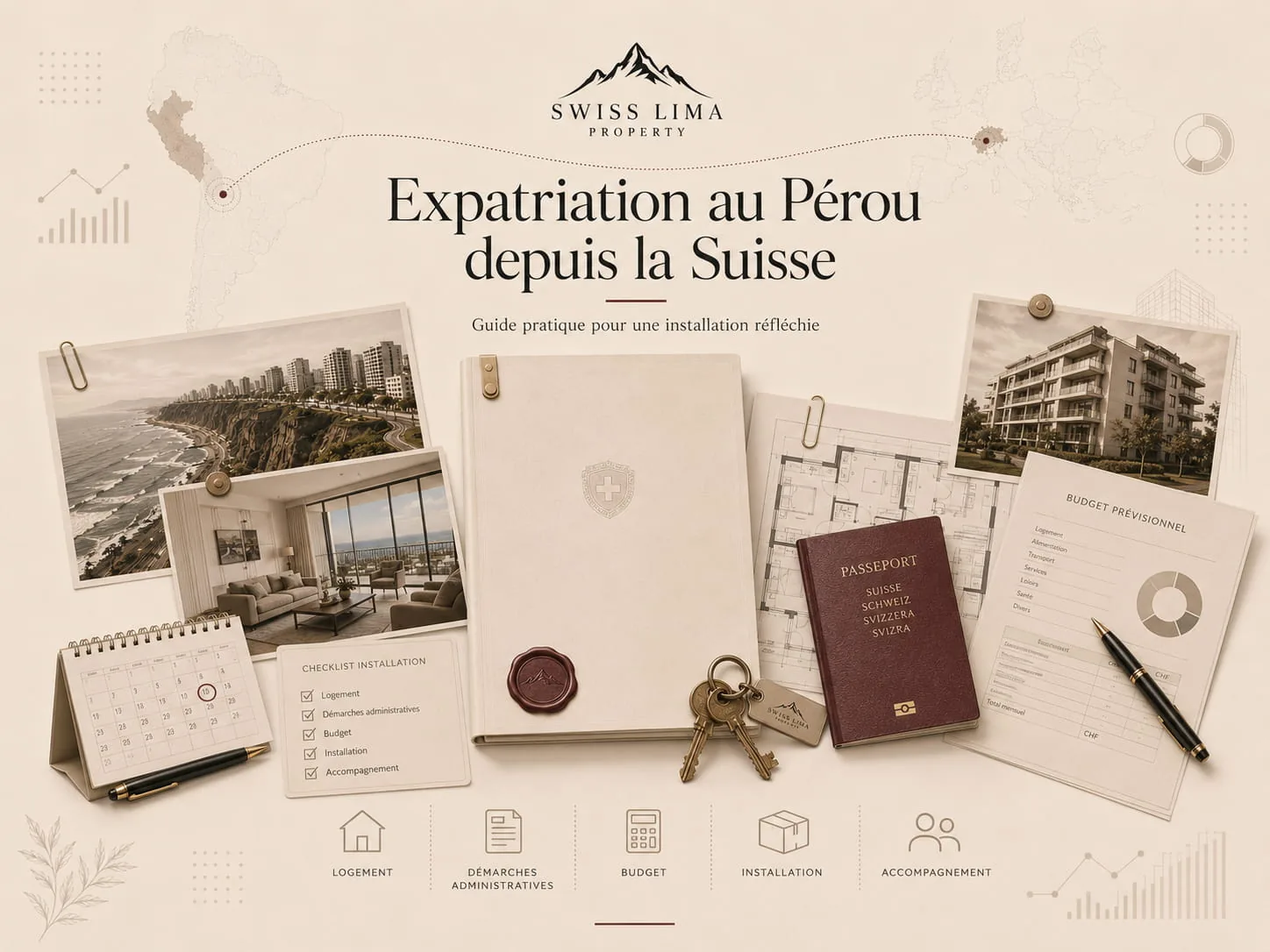
Beyond the visa: what relocation truly involves
The first question a Swiss national considering a move to Peru asks is usually "which visa do I need?" That is a legitimate question, but it represents only a fraction of what such a step entails. Moving to Peru from Switzerland touches at least six distinct dimensions: immigration status, taxation in both countries, social and medical coverage, housing, management of assets remaining in Switzerland, and family organisation.
This guide addresses each of these dimensions factually. It aims neither to discourage nor to encourage: it aims to allow a decision based on complete information. Beyond the administrative steps, a successful relocation also depends on reading the local social codes correctly: our guide on cultural differences between Peru and Switzerland helps you understand attitudes toward time, family and administration in daily life.
Preparing your departure from Switzerland
A successful relocation begins well before the departure date. Here are the priority steps to initiate on the Swiss side:
- Notify your municipality of departure: inform your commune's residents' office of your move abroad. This step is essential to close Swiss tax liability and resident AVS obligations.
- Clarify your AVS situation: AVS contributions and pensions merit verification with the Swiss Compensation Office (CSC/ZAS), particularly for those wishing to maintain voluntary contributions from abroad.
- Organise international health coverage: LAMal does not cover care abroad without limits. On permanent departure from Switzerland, international health insurance must be taken out before leaving.
- Consult a tax advisor: the change of fiscal domicile has implications for income tax, wealth tax and any Swiss real estate you may hold. A prior consultation is essential.
- Check residence conditions in Peru: contact the Peruvian embassy in Switzerland or consult the official Migraciones portal to identify the immigration status suited to your situation.
Choosing your status: stay, residence or long-term settlement
Immigration status depends on the length of stay and the project planned in Peru.
Short tourist stay: Swiss nationals can generally enter Peru without requesting a visa in advance. The authorised length of stay is set by the immigration authorities upon entry into the country. Tourist status allows travel and stays in Peru, but not the exercise of a paid professional activity.
To live in Peru on a more lasting basis, several residence statuses can be considered:
Rentista residence: for people with a pension or permanent, regular income from Peru or abroad. Particularly suited to retirees.
Worker residence: for people carrying out a professional activity in Peru. It can also apply to a self-employed worker with a service contract that meets immigration requirements.
Family residence: accessible in particular to the spouse, the partner in an officially registered civil union, children or certain relatives of a Peruvian citizen or a foreign resident.
Investor residence: for foreigners who create, develop or manage a business or economic activity in Peru. Buying an apartment for personal or rental use does not, by itself, qualify for this status.
Conditions, documents and timelines vary by situation. Swiss Lima Property can refer you to competent professionals to identify the status best suited to your project.
Finding housing in Lima
Lima is a large and heterogeneous city. For a European expatriate, the choice of neighbourhood is decisive: it determines safety, access to services and daily quality of life.
The most popular districts for expatriates are in the south of Lima: Miraflores, San Isidro, Barranco, Surco and La Molina. These districts offer quality apartments, well-maintained streets, parks, well-stocked supermarkets, restaurants and private clinics nearby. They also concentrate most of the services suited to foreigners: English or French-speaking doctors, international banks, international schools.
The rental market for a 2 to 3-bedroom apartment in these districts sits, indicatively, between USD 600 and 1,500 per month depending on the standard and location.
Rent before you buy
For an expatriate arriving in Lima, renting during an initial period (6 months to 2 years) is almost always the best approach. This phase allows you to:
- test different neighbourhoods and identify which one best matches your lifestyle;
- understand the local real estate market before investing in it;
- validate the life project in Peru before any long-term financial commitment;
- have the time needed to organise the administrative, fiscal and patrimonial aspects of a purchase from Switzerland.
A property purchase made too quickly, under time pressure or first-month enthusiasm, is one of the most frequent mistakes among expatriates. It is always preferable to approach a purchase with grounded market knowledge and a clear project vision.
Banking and day-to-day finances
Day-to-day financial management in Lima generally requires a local bank account. Major Peruvian banks (BCP, BBVA Perú, Interbank, Scotiabank) offer accounts in soles (PEN) and US dollars (USD). Daily transactions in Lima are mainly in soles, though dollars are widely accepted in expatriate-oriented businesses and services.
Opening a Peruvian bank account generally requires a passport, a Carné de Extranjería (issued to residents) and a Peruvian address. For non-residents, the process may be more complex: check with banks directly.
Maintaining an active Swiss bank account is useful, particularly to receive Swiss income (pension, rental income, dividends) and manage assets remaining in Switzerland. International transfers between Switzerland and Peru are facilitated by services such as Wise (TransferWise) or multi-currency banking offers.
A multi-currency solution such as Revolut can also be practical for paying in soles, converting CHF or EUR and withdrawing money in Peru. It is a good complement for everyday expenses, but does not always replace a Peruvian bank account for rent, direct debits or local procedures. Fees and limits depend on the subscription plan and should be checked before use.
Healthcare and medical coverage
Healthcare is one of the primary concerns of any expatriate. In Lima, medical care for expatriates is provided exclusively in the private sector.
Lima offers adequate private medical care for routine needs: general medicine, basic cardiology, orthopaedics, ophthalmology, dentistry. Major clinics (Clínica Anglo Americana, Clínica Ricardo Palma, Clínica Internacional, among others) employ internationally trained doctors and offer consultations in Spanish, sometimes in English.
For severe pathologies or highly specialised care, the capacity of Lima's establishments may prove insufficient. Recourse to American (Miami, Houston) or European hospitals is sometimes necessary for complex cases.
An international health insurance covering care in Peru, care in third countries and medical repatriation is essential. This insurance must be taken out before departure and adapted to the insured person's age and health status.
Taxation: Swiss and Peruvian obligations
The taxation of a Swiss national settling in Peru is a complex subject that deserves careful attention.
Swiss side
Leaving Switzerland to settle in Peru in principle ends your liability to Swiss income tax, provided the break in fiscal domicile is effective. However, certain obligations may remain: withholding tax on Swiss-source income (rental income, dividends from Swiss companies, pension payments), residual wealth tax in some cantons. Switzerland and Peru have a double taxation agreement in force since 10 March 2014; it does not replace an individualised fiscal residency analysis.
Peruvian side
Peru taxes Peruvian-source income of non-residents at a flat rate. For a resident in Peru, worldwide income may be subject to Peruvian income tax under local residency rules. Rental income from a property in Lima must be declared to SUNAT, regardless of where the owner resides.
The Switzerland–Peru double taxation agreement exists; it does not automatically cover every case. Fiscal exit from Switzerland, Peruvian real estate income, wealth and bank accounts must each be analysed on a case-by-case basis by a professional competent in both countries.
Schooling (if you have children)
Lima offers a choice of international schools suited to expatriate families. Well-established institutions offer curricula in English (American or British programme), Spanish or the International Baccalaureate (IB). Among the most recognised establishments:
- Colegio Pestalozzi, offering a Spanish-language curriculum with Swiss and European orientation;
- Markham College and British School, in English, in the British tradition;
- Colegio Franklin D. Roosevelt (American school);
- Alliance Française, for French-speaking families.
Tuition fees are significant and must be factored into an expatriate family's annual budget. They vary by institution and school level.
Safety and neighbourhood choice
In Lima, the level of safety varies considerably by area. Residential districts such as Miraflores, San Isidro, Barranco, Surco, San Borja or La Molina generally offer a pleasant, well-maintained and better-secured living environment, with private patrols, monitored buildings, well-lit streets and plentiful local shops.
As in any large metropolis, a few simple habits allow you to get around with peace of mind: favour recognised ride-hailing apps, stay discreet with valuables, and progressively get to know the city's different neighbourhoods.
For families, Surco, La Molina and San Borja are particularly appreciated for their calm environment, green spaces, schools and sports facilities.
Managing Swiss assets from Lima
Many Swiss expatriates retain assets in Switzerland after settling in Peru: real estate, bank accounts, securities portfolios, occupational pension (2nd pillar). Managing these remotely is entirely possible, provided agents and powers of attorney are organised in advance.
Key points to consider:
- Swiss real estate: managing a Swiss property from Lima requires a trusted property manager or administrator on the ground. Swiss rental income remains subject to Swiss taxation (withholding tax or declaration, depending on the case).
- Swiss bank accounts: KYC (Know Your Customer) compliance requirements of Swiss banks can raise questions for non-residents. Check with your bank the conditions applicable upon your departure.
- Occupational pension (2nd pillar): on permanent departure from Switzerland, specific rules apply to withdrawing pension capital. Consult your pension fund and a tax advisor before taking any steps.
Buying real estate in Peru
Buying property in Peru is accessible to foreigners without any residence requirement. The Peruvian Constitution (article 71) guarantees foreign nationals the same property rights as Peruvian citizens.
For an expatriate settled in Lima, purchasing an apartment may serve several purposes: having a stable primary residence, significantly reducing long-term monthly costs, or forming part of a patrimonial diversification strategy. An acquisition in Lima involves entry costs (alcabala, notary fees, registration fees, legal fees) of approximately 4 to 7% of the purchase price.
Purchasing from Switzerland without being present in Lima is possible: certain agents can act on your behalf by notarised power of attorney. However, property selection, title audit and negotiation require a local presence or a trusted representative.
Swiss Lima Property supports you at every step
From property selection to coordination with the notary and local attorney, our team guides you throughout the acquisition process in Lima, including title verification and introductions to reliable professionals.
Role of Swiss Lima Property
Swiss Lima Property is a real estate accompaniment specialist for Swiss and Europeans investing or settling in Lima. Our role in a relocation project covers:
- Life project analysis: helping identify the neighbourhood and property type corresponding to real needs (family, individual, couple, retiree, active professional).
- Property selection: presenting verified properties with clean titles and serious vendors.
- Local coordination: acting as point of contact between the client, notary, attorney and vendors.
- Professional referrals: recommending lawyers, tax advisors, notaries and property managers from our qualified partner network.
- Property management: if the property is purchased but not occupied full time, organising and supervising rental management.
Our approach is structured and patrimonial. We work with clients who take the time to prepare their project and expect an objective perspective from us at each stage, without pressure.
Sources
- Superintendencia Nacional de Migraciones: migraciones.gob.pe
- SUNAT (Superintendencia Nacional de Administración Tributaria): sunat.gob.pe
- Swiss Federal Tax Administration (FTA): estv.admin.ch
- Swiss Compensation Office (CSC/ZAS), AVS information abroad: zas.admin.ch
- Political Constitution of Peru, article 71 (property rights of foreigners)
- State Secretariat for International Financial Matters (SIF) — Switzerland–Peru Double Taxation Agreement (in force since 10 March 2014): sif.admin.ch