
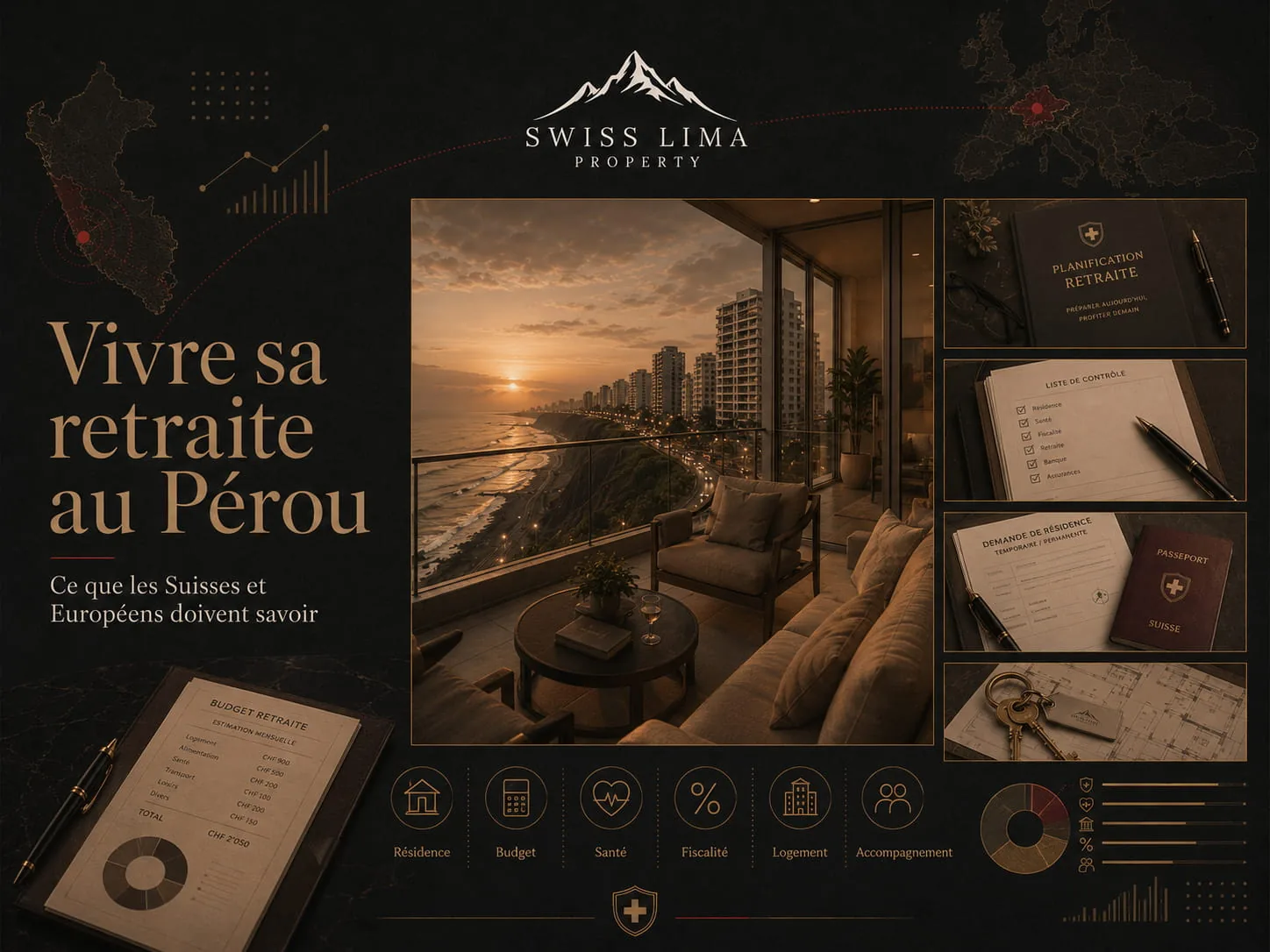
Peru as a retirement option: neither paradise nor ordeal
Peru is not the most frequently cited destination in discussions about retiring abroad, but it appears regularly in the thinking of Swiss and European nationals drawn to Latin America. The reasons tend to be consistent: a cost of living significantly lower than Switzerland's, a temperate climate on the Pacific coast, recognised cultural richness and, for some, personal or family ties already established in the region.
This guide does not seek to persuade, but to present this option objectively. Retiring in Lima can offer many advantages, provided the move is well prepared: adapting to the language and local lifestyle, choosing suitable health coverage, selecting the right neighbourhood and organising the fiscal and patrimonial aspects.
For certain profiles, Lima represents a coherent option. For others, it does not fit. The purpose of this guide is to provide the elements needed for this assessment.
Lima, Arequipa, Cusco, northern coast: the main options
Peru is a country of great geographical and climatic diversity. For a European retiree, the choice of city is not trivial: it determines lifestyle, access to healthcare, international connectivity and local cost of living.
Lima
Lima concentrates around 11 million inhabitants and represents, by far, the most popular destination for expatriates. Its advantages for a foreign retiree are considerable: an acceptable network of private clinics, an international airport with good connections to Europe (via Madrid, Amsterdam or Miami), a dense cultural and gastronomic offer, and secure residential neighbourhoods with adapted infrastructure. The districts of Miraflores, San Isidro and Barranco offer a quality living environment with shops, parks, restaurants and services within easy reach. Lima has no marked seasons in the European sense: the sky is often grey from May to November (the garúa coastal mist), but temperatures remain mild, between 14 and 27 degrees Celsius throughout the year.
Arequipa
Arequipa, the "white city", draws visitors with its colonial architecture and near-constant sunshine. Situated at 2,300 metres altitude, it offers a quieter setting than Lima, with an even lower cost of living. Access to specialist medical care is more limited than in Lima, and international flight connections require a transit through Lima. For a retiree in good health seeking a serene and culturally rich environment, Arequipa is a serious option.
Cusco
Cusco (3,400 m altitude) attracts those interested in Inca heritage and cultural tourism, but its altitude can cause health problems for older people or those with cardiovascular conditions. The healthcare system there is more limited. For a retiree, Cusco is better suited as a tourist base than as a permanent residence.
Northern coast: Trujillo, Piura, Máncora
The northern coast benefits from more consistent sunshine than Lima and a warmer climate. Cities such as Trujillo (around 900,000 inhabitants) offer very low living costs and an authentic local life, but specialist medical infrastructure is limited and international connections require a transit through Lima.
Monthly budget for a European retiree
The cost of living in Peru is significantly lower than in Switzerland, but it varies considerably by lifestyle and neighbourhood. The estimates below concern Lima, in the residential districts of the south (Miraflores, San Isidro, Barranco).
| Expense category | Monthly estimate (USD) |
|---|---|
| Rent (2-bedroom apartment, residential district) | 600 to 1,200 |
| Food (markets and supermarkets) | 200 to 400 |
| Restaurants and outings | 150 to 350 |
| Transport (taxi apps) | 80 to 150 |
| International private health insurance | 150 to 400 |
| Utilities (internet, phone, electricity) | 80 to 130 |
| Leisure, culture, internal travel | 100 to 300 |
| Indicative total | USD 1,360 to 2,930 |
These figures are orders of magnitude, not guarantees. A retiree who owns their apartment in Lima will have significantly lower monthly expenses. Conversely, a lifestyle centred on gourmet restaurants and regular trips to Europe may exceed these estimates.
Housing: rent or buy
The housing question is central to any retirement project abroad. Two approaches coexist, and both are legitimate depending on individual circumstances.
Renting is often the first instinct, and it is reasonable. It allows testing a neighbourhood, evaluating daily life in an unfamiliar environment, and retaining flexibility that ownership does not permit. The rental market in Lima for residential districts (Miraflores, San Isidro, Barranco, Surco) offers well-maintained apartments at prices accessible to a European retiree with a Swiss pension or capital.
Buying can become relevant once the life project is confirmed and the acquisition forms part of a broader patrimonial reflection. An apartment in Lima can serve as a primary residence, significantly reduce monthly expenses, and represent a transmissible asset. The property rights of foreigners are protected by the Peruvian Constitution (article 71), without any residence requirement.
Some retirees adopt a mixed approach: renting for one or two years, then purchasing with full knowledge of the local market. This sequence is often the most prudent.
Healthcare and access to private medical care
The Peruvian public healthcare system has significant shortcomings. For a foreign retiree, the healthcare question must be addressed exclusively within the private sector.
Lima has a network of private clinics that adequately address routine care, general medicine, basic cardiology, orthopaedics and standard planned surgery. Among the most reputable establishments are the Clínica Anglo Americana (San Isidro), the Clínica Ricardo Palma (Miraflores), the Clínica Internacional and the Clínica San Borja. The level of care there is satisfactory for a significant proportion of the routine medical needs of a retiree.
However, for complex pathologies (advanced oncology, neurosurgery, severe cardiac conditions), the capacity of Lima's establishments may prove insufficient. Patients are regularly transferred to hospitals in the United States or Europe for major interventions.
An international health insurance covering medical repatriation is essential. It must be taken out before settling in Peru, ideally with an insurer specialising in expatriate coverage (Cigna Global, Allianz Care, AXA Global Healthcare, among others).
Safety and neighbourhood choice
Safety in Lima varies considerably by neighbourhood. The city is vast and highly contrasted: some areas require greater vigilance, while residential districts such as Miraflores, San Isidro, Barranco, Surco or La Molina offer a much calmer and better-organised living environment.
In areas such as San Isidro or Miraflores, the level of safety can even exceed that of some Western European cities, thanks to the presence of guards, private patrols, well-lit streets and numerous surveillance measures. These districts are particularly suited to retirees wishing to get around on foot and enjoy parks, restaurants and shops in a pleasant environment.
As in any large metropolis, a few simple habits remain advisable: avoid unnecessarily displaying valuables, favour recognised ride-hailing apps, and progressively discover the city, ideally with the help of people who know the different neighbourhoods well.
Immigration status: the rentista visa and other options
To stay more than 90 days per year in Peru, or to settle permanently, a residence status is required. The most relevant category for a retiree is the rentista: it addresses people with regular and sufficient passive income (retirement pension, annuities, dividends, capital returns).
This status allows obtaining a temporary residence in Peru, renewable annually, and leading to permanent residence after several years. It does not require productive investment in Peru and corresponds well to the profile of a European retiree benefiting from a Swiss pension or a well-constituted capital.
The precise conditions (minimum justified monthly income, documents required, filing procedure) are defined by the Superintendencia Nacional de Migraciones and may evolve. They must be verified directly on the official portal (migraciones.gob.pe) or with a specialist immigration attorney.
Swiss and Peruvian taxation
The fiscal dimension of a retirement project abroad is often the most complex and the most overlooked. It deserves serious attention and professional guidance.
Swiss side
Leaving Switzerland to settle in Peru has Swiss fiscal consequences. Liability to income tax in Switzerland generally ceases at the time of establishment abroad, provided the break in fiscal domicile is effective and documented. The question of the AVS (old-age and survivors' insurance) is distinct: AVS pensions are paid abroad, but voluntary contributions and social coverage abroad merit verification with the competent authorities. Wealth held in Switzerland may remain subject to wealth tax if the canton of departure still applies it partially.
Peruvian side
Peru taxes income from Peruvian sources for non-residents. For a retiree receiving only a Swiss pension and not owning Peruvian assets, tax exposure in Peru is limited. However, if you receive rental income from an apartment in Lima, you will have declaratory and tax obligations with the SUNAT (Superintendencia Nacional de Administración Tributaria), regardless of your place of residence.
Switzerland and Peru have a double taxation agreement on income and capital in force since 10 March 2014. Its application to pensions (including AVS/LPP), rental income and Swiss wealth depends on the income type, canton and actual fiscal residence. A qualified tax adviser with expertise in both systems should be consulted before making any fiscal exit from Switzerland.
Family ties, connectivity and patrimonial management
Settling in Lima does not mean cutting ties with your country of origin. International connectivity is well developed: Lima is connected to Madrid, Amsterdam, Miami and other major hubs, allowing regular trips back to Europe. A Lima-Geneva flight takes approximately 14 hours with a stopover.
Managing assets in Switzerland (bank accounts, securities portfolios, real estate) can be maintained remotely with good organisation, trusted agents and, where necessary, notarised powers of attorney. Some retirees maintain a Swiss domicile for their Swiss assets while living part of the year in Lima.
The family dimension is important: if children and grandchildren are in Switzerland, the retirement project must integrate back-and-forth travel, family stays and availability for important events. Lima is not a choice imposed on an entire family: it is a personal life choice requiring the adhesion, or at least the understanding, of close family members.
For those considering a real estate purchase in this context, the question of patrimonial transmission also arises: Peruvian succession rules, the role of heirs, applicable taxation. These subjects require the support of a Peruvian notary and a tax advisor in both countries.
Role of Swiss Lima Property
Swiss Lima Property is not a tax, immigration or medical advisor. Our role is specific: accompanying Swiss and Europeans in their reflection and real estate decisions in Lima.
In the context of a retirement project, this includes:
- analysing the districts best suited to a retiree's lifestyle (accessibility, safety, proximity to healthcare, neighbourhood life);
- selecting properties corresponding to a comfortable lifestyle, as a primary residence or rental investment;
- directing clients towards qualified lawyers, notaries and tax advisors in both countries, from our partner network;
- accompanying the purchasing process remotely, from visit to signature at the notary;
- setting up property management if the property is not occupied full time.
Our approach is patrimonial and structured: we work with clients who take the time to analyse their project before acting, and who expect an objective view from us, not a sales pitch.
Sources
- Superintendencia Nacional de Migraciones: migraciones.gob.pe
- SUNAT (Superintendencia Nacional de Administración Tributaria): sunat.gob.pe
- Numbeo: cost of living in Lima (participative data, indicative): numbeo.com
- INEI (Instituto Nacional de Estadística e Informática): inei.gob.pe
- Political Constitution of Peru, article 71 (property rights of foreigners)
- State Secretariat for International Financial Matters (SIF) — Switzerland–Peru Double Taxation Agreement (in force since 10 March 2014): sif.admin.ch