
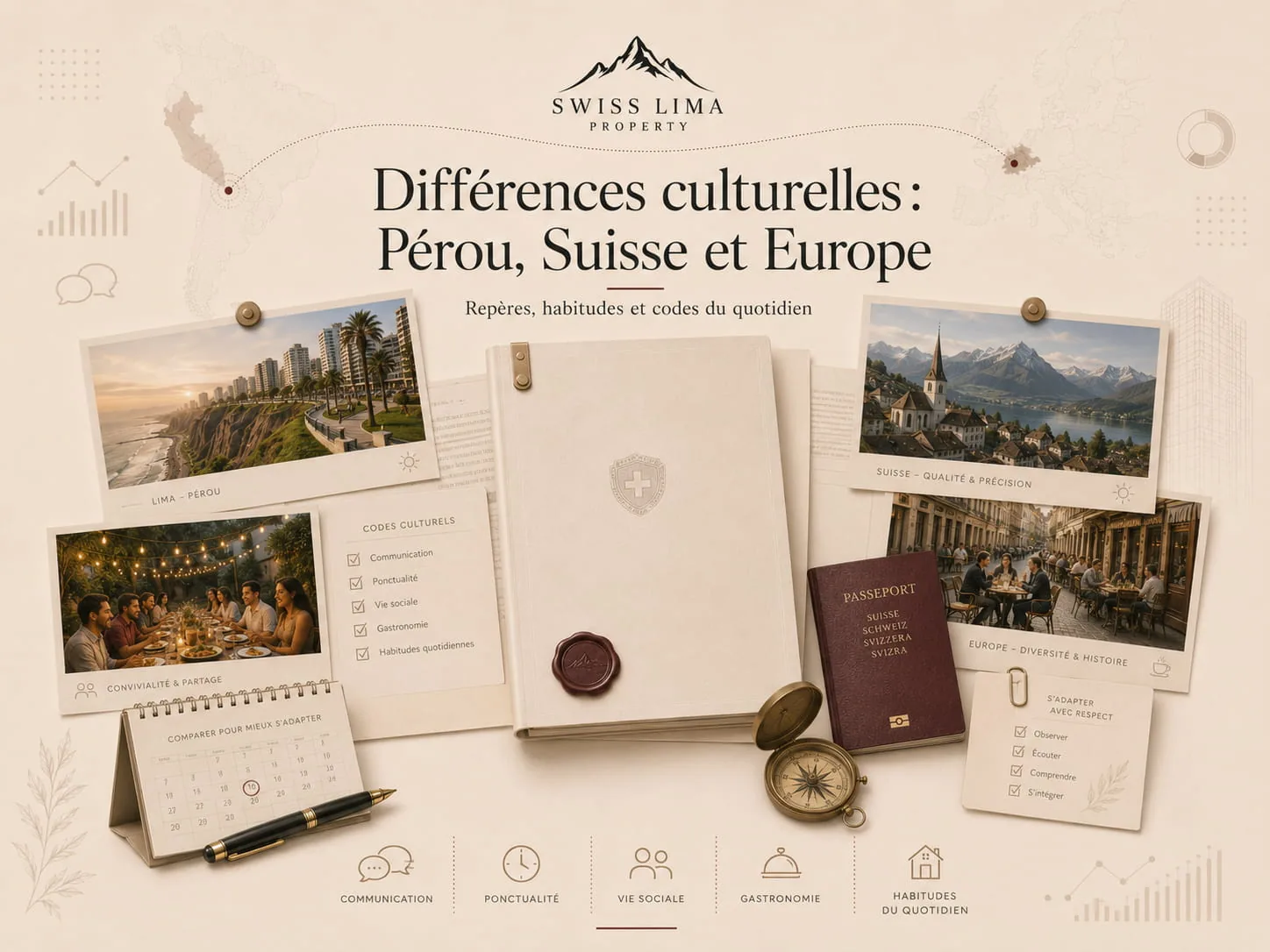
Why cultural differences matter so much
Cultural differences are not simple folklore to observe from a distance: they directly shape small everyday situations. Making an appointment, waiting for an answer, understanding a "yes" that is not always a firm commitment, negotiating a service, being welcomed into a family, handling an administrative process, reading a silence, building trust, or simply feeling at ease in a city like Lima: each of these situations is shaped by cultural codes that do not always look alike from one country to another.
It should also be said that Peru is a very diverse country, with different realities between Lima, the north coast, the Andes, the Amazon, urban settings and more traditional contexts. The tendencies described here, which mostly concern urban life and Lima in particular, are not found everywhere with the same intensity. To better grasp this geographic diversity, our guide on Peru's three regions details the distinct logics of the coast, the Andes and the Amazon.
The mistake to avoid
Do not confuse cultural difference with a lack of seriousness. A more flexible pace, more indirect communication, or greater weight given to personal relationships does not necessarily mean an absence of professionalism. It takes practice to read the context correctly.
Attitudes toward time and punctuality
In Switzerland and much of Europe, punctuality is often seen as a mark of respect. Schedules strongly structure professional life, appointments are prepared in advance, deadlines are taken literally, and cancelling or rescheduling at the last minute can be poorly received. Planning ahead is reassuring and is part of the implicit expectations of a serious relationship.
In Peru, time can be experienced more flexibly depending on the context. In the formal professional world, punctuality remains important and expected. In social life, on the other hand, being late is often more tolerated, and the unexpected is more a part of daily life: traffic, distances, errands or logistics can change a schedule along the way. It would nonetheless be inaccurate to claim that Peruvians are systematically late: the reality mostly depends on the type of appointment and the context.
Advice for a Swiss or European visitor
Confirm important appointments the day before or a few hours ahead. Build in a margin. Distinguish between a business meeting, a property viewing, a family invitation and an informal get-together: expectations are not always the same.
Direct communication or relational communication
Many Swiss and Europeans favour structured, clear, direct, solution-oriented communication: state the problem, then look for an answer. In Peru, depending on the context, communication can be more relational: the tone used, politeness and the overall mood of the conversation often matter as much as the content. It is common to avoid making the other person lose face, to soften a refusal that would otherwise sound too blunt, to take time to set a warm atmosphere before addressing the topic, or to use polite formulas before getting to the point.
The word "sí" can therefore carry several meanings depending on the situation: yes, I understood, I will try, I don't want to contradict you directly, or I agree in principle but it still needs to be confirmed. This is not a lack of sincerity: it is simply a different way of handling disagreement and uncertainty in conversation.
A "yes" is not always a final confirmation
In a cross-cultural context, it helps to calmly rephrase: "So we're confirming Tuesday at 10am?" or "Is this date already firm, or still to be confirmed?"
A few useful Spanish phrases to clarify things without sounding pushy:
- "¿Está confirmado?"
- "¿Me puede confirmar por WhatsApp?"
- "¿Para qué hora exactamente?"
- "¿Hay algo más que debo preparar?"
- "Perfecto, quedo atento/a."
The place of family and close relations
Family often occupies a very important place in Peruvian social life. Many decisions are discussed with close relatives, parents, siblings and cousins frequently play an active role, family meals hold a central place, and support between generations remains very present. Introducing a partner or friends to the family is often experienced as a significant social step, not a mere formality.
In Switzerland and Europe, individual independence is often valued more highly. Private life stays more separate from the extended family, personal decisions are sometimes discussed less systematically with relatives, and geographic or emotional distance from family can be greater without this being seen as a problem. That said, Peruvian family life should not be portrayed as overbearing, nor European family life as cold: the balances are simply different.
What this changes in practice
For a move, a personal relationship or a long-term project in Peru, understanding someone's family circle often helps to understand their decisions, priorities, availability and expectations. It's also worth factoring in if you're considering a longer-term move to Lima.
Formality, respect and hierarchy
Peru can be warm in day-to-day interactions while remaining fairly formal in certain settings. Professional titles are often used ("señor", "señora", "doctor", "ingeniero", "licenciado" depending on the context), respect for older people is very present, greeting people properly matters, and appearance can count in certain professional circles. The formal "usted" remains common in formal situations.
In Switzerland, formality is also present, but often more institutional: it runs more through codified rules and respect for procedure than through an explicit display of respect within the exchange itself. Hierarchy tends to be more discreet, and emotional expression more contained in a professional setting.
Formal or informal address?
In Peruvian Spanish, starting with "usted" in a formal context or with an older person is usually the safer choice. Switching to "tú" depends on context, age, closeness, and the implicit or explicit invitation of the other person.
Administration, patience and flexibility
For a Swiss or European visitor, Peruvian administration can feel less predictable: more dependent on physical documents, more attached to copies, signatures and successive approvals, sometimes less clear on announced deadlines, variable from one institution to another, and requiring more active follow-up from the applicant.
In Switzerland, trust in procedures is strong, deadlines are generally better announced, digitalisation is more advanced, and the relationship with administration remains more structured around standardised documents. It would nonetheless be inaccurate to call Peruvian administration "bad": it mostly requires more anticipation, more patience, and often, local support to avoid losing time on steps that are poorly understood.
Preparing an administrative process in Lima?
In a purchase or relocation project, the difference is not just about language. It's also about documents, local practices, timelines, the right contacts, and how each step is followed up.
Service, negotiation and the business relationship
In Switzerland and much of Europe, prices are more often fixed, processes are more standardised, service is more clearly framed, and negotiation remains rare in ordinary shops. The written contract holds a central place, and expectations around timelines or after-sales service are generally precise.
In Peru, negotiation is more present in certain contexts, personal contact matters more, and WhatsApp is very widely used to exchange with a shopkeeper or a service provider. Replies can be quick but informal, which makes it necessary to explicitly clarify what is actually included. The business relationship is often more personal, and there is a real difference between a market stall, a small shop, an independent provider, a formal agency and a structured company. Our guide to Gamarra, Lima's great textile district, illustrates this culture of negotiation and close-contact commerce well.
Before confirming a service
Always check: the exact price, the currency used, what is included, the timeline, the payment method, the cancellation terms, the person responsible, and get written confirmation by WhatsApp or email.
Work, trust and personal networks
In many Peruvian contexts, trust is built above all through relationships: a recommendation, a network, a personal contact, a shared history, proximity or the reputation of a reliable intermediary often carry more weight than a simple document. In Switzerland, trust is often more institutional, carried by certification, the contract and the procedure; reputation still matters, but within a more standardised framework.
For a European, it can be surprising that some exchanges first go through WhatsApp, a personal contact or a recommendation, before entering a more formal framework. This is not a sign of amateurism: it is simply a different way of establishing trust before committing.
The role of a local point of contact
In an environment you don't yet know well, a local point of contact does more than translate. It helps you understand who to contact, how to phrase a request, when to follow up, which signals to watch for, and which documents to check.
Money, status and social appearances
Attitudes toward money, status and appearance can differ by social circle, on both sides. In Peru, appearance can count in certain professional or social settings; brands, the car, the neighbourhood or the venue can sometimes play a social role, family or social generosity can be valued, and social inequalities can be more visible in public space than in Switzerland. Understanding the cost of living and budget gaps in Lima also helps to put these social realities into perspective.
In Switzerland and Europe, financial discretion is often valued, wealth is sometimes displayed less openly, attitudes toward social status remain more understated, material and institutional security is stronger, and inequalities are sometimes less visible in public space.
An important note
Do not turn this section into a moral judgement. Attitudes toward status depend heavily on social background, age, city, profession and each person's personal history.
Everyday life, noise, space and security
Lima can feel noticeably louder than a Swiss city: car horns, dense traffic, street vendors, music and neighbourhood life create a different kind of urban intensity, with rhythms that vary a great deal by district. In public space, pavements are sometimes uneven, traffic is denser, driving is more intuitive, and pedestrian crossings are less consistently respected than in Switzerland: staying alert remains a good habit.
On security, some nuance is needed: some Lima neighbourhoods are very pleasant and residential, but caution generally needs to be higher than in Switzerland. Avoiding displaying valuables, favouring ride-hailing apps, and checking conditions according to neighbourhood and time of day are simple habits to adopt, without extending this vigilance to the entire country. Our page on Lima's districts details the characteristics of each sought-after area.
Meals, invitations and hospitality
Meals play an important social role in Peru: sharing food, being generous with portions, and politely insisting that a guest take a little more are all part of the codes of hospitality. Lunch is sometimes more important than dinner, a cevichería is often associated with the midday meal, and Sunday family lunch remains an institution in many households. Thanking one's host holds an important place in this social ritual. To go further into this culture through food, our guide to Peruvian gastronomy presents its dishes and regional traditions.
In Switzerland and Europe, invitations are often planned further in advance, schedules are stricter, portions and the course of a meal are more codified, and the separation between social life and private life is a bit sharper.
Religion, festivals and traditions
Peru blends a Catholic heritage, pre-Hispanic traditions, local festivals, processions, carnivals and regional celebrations, within a strong sense of community and attachment to religious or family dates. Peru Travel lists a very large number of popular festivals held across the country each year, from processions and carnivals to patron saint festivals and local rituals. It would nonetheless be reductive to sum up Peru through its religious dimension alone: the intensity of practice varies a great deal by person, generation and region.
In Switzerland and Europe, secularisation is more pronounced in several countries, religion tends to stay more discreet in public space, festivals are more institutionalised, and the differences between European countries themselves remain strong on this topic.
Summary table: Peru vs Switzerland / Europe
This table summarises the tendencies presented in this guide. It is not a ranking: no column is "better" than the other, only different.
| Topic | Switzerland / Europe tendency | Peru tendency | Practical advice |
|---|---|---|---|
| Punctuality | Strict, a mark of respect | More flexible socially, strict professionally | Confirm the day before, build in a margin |
| Communication | Direct, solution-oriented | Relational, contextual | Rephrase to confirm |
| Family | Independence valued | Close family very present | Understand who really decides |
| Administration | Digitalised, deadlines announced | Paper-based, active follow-up needed | Anticipate, follow up, get local support |
| Work | Institutional trust | Trust built through relationships | Go through a network or a recommendation |
| Negotiation | Rare, fixed prices | More common depending on context | Clarify in writing what is included |
| Business relationship | Standardised, contractual | Personal, via WhatsApp | Get written confirmation |
| Hierarchy | Discreet, codified | Formality and titles emphasised | Favour "usted" at first |
| Social life | Planned, private life kept separate | Spontaneous, family very present | Stay open to the unexpected |
| Security | Low vigilance | Vigilance varies by district | Check conditions by area and time |
| Meals | Codified, strict timing | Sharing, generosity, Sunday family lunch | Accept the host's polite insistence |
| Festivals and traditions | Secularised, institutionalised | Numerous, regional, community-based | Check the local calendar |
Tips to avoid misunderstandings
Beyond understanding these gaps in theory, a few simple habits help avoid most everyday misunderstandings.
- Confirm without pushing. Ask for a clear confirmation while remaining polite.
- Leave a time margin. Don't stack important appointments back to back without breathing room.
- Put it in writing. Use WhatsApp or email to confirm address, time, price, documents and next steps.
- Don't jump to conclusions. A delay, a vague answer or a needed follow-up do not automatically mean bad intent.
- Learn a few Spanish phrases. "Con mucho gusto", "Quedo atento/a", "¿Me podría confirmar?", "Disculpe la molestia", "Gracias por su tiempo".
- Observe before judging. Understand local codes before applying your own expectations.
- Rely on a trusted local contact. For important projects, avoid improvising alone.